
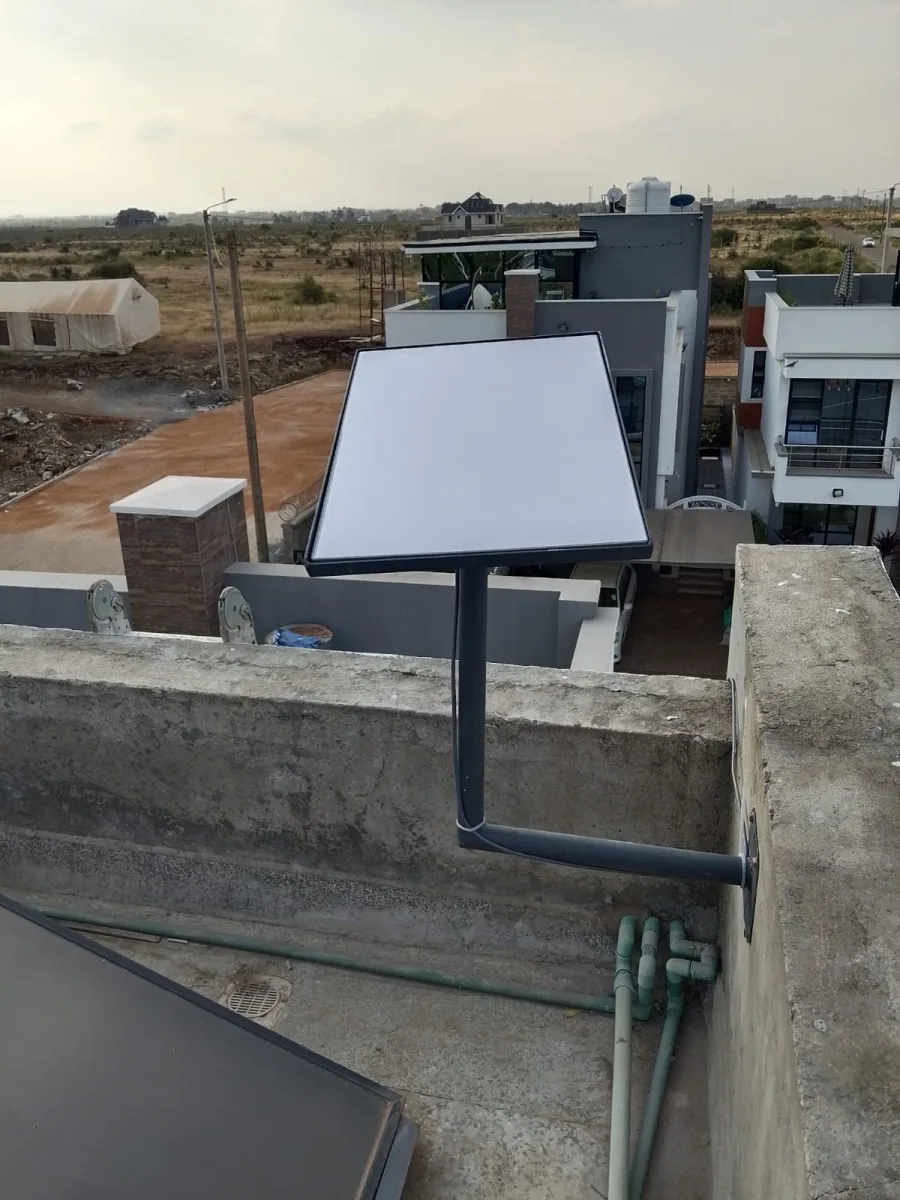
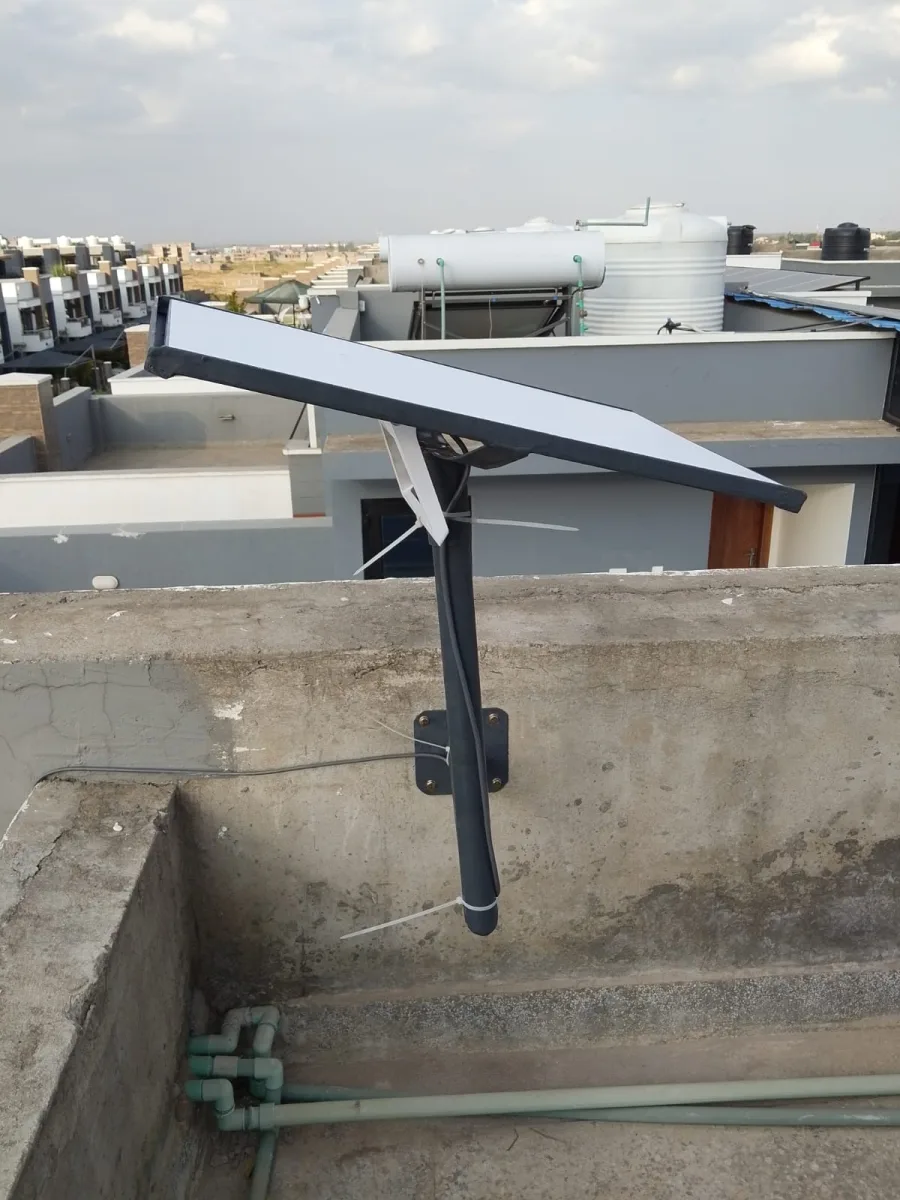
Need Starlink Installation or Network Optimization?
We help homes, offices, apartments, and businesses with Starlink installation, WiFi coverage improvement, and professional setup in Kenya.
Request Installation Chat on WhatsAppTransparent CCTV Cost Planning
Talk to Spacekits
Need Starlink help for your home or business?
Talk to Spacekits before you buy or book installation. We help with kit supply, mounting, activation, router placement, WiFi coverage, and written quotes.
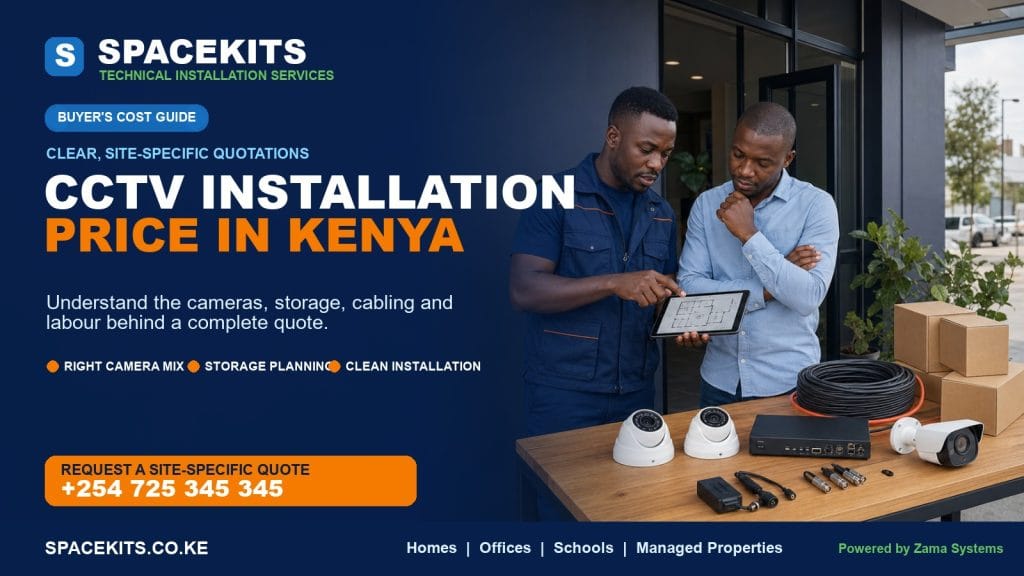
CCTV Installation Price in Kenya: A Practical Cost and Package Guide
The price of CCTV installation in Kenya depends on what the system must see, record and protect. A four-camera package for a compact shop cannot be priced responsibly in the same way as four long-range outdoor cameras on a large compound. Camera specification, recorder capacity, storage, cable distance, mounting access, power backup, network work and the required finish all change the quotation.
This guide does not publish an invented SpaceKits price list. Instead, it shows you how a professional quotation is built, what to compare in four-camera, eight-camera and sixteen-camera plans, and how to avoid a cheap package that leaves out storage, suitable cabling or important installation work. Use it to prepare your requirements and request a quote that can be compared line by line.
If you already know the property type, priority areas and preferred recording period, ask SpaceKits for a site-based proposal. If you are still deciding, the sections below will help you turn a vague request for “CCTV cameras” into a clear security brief.
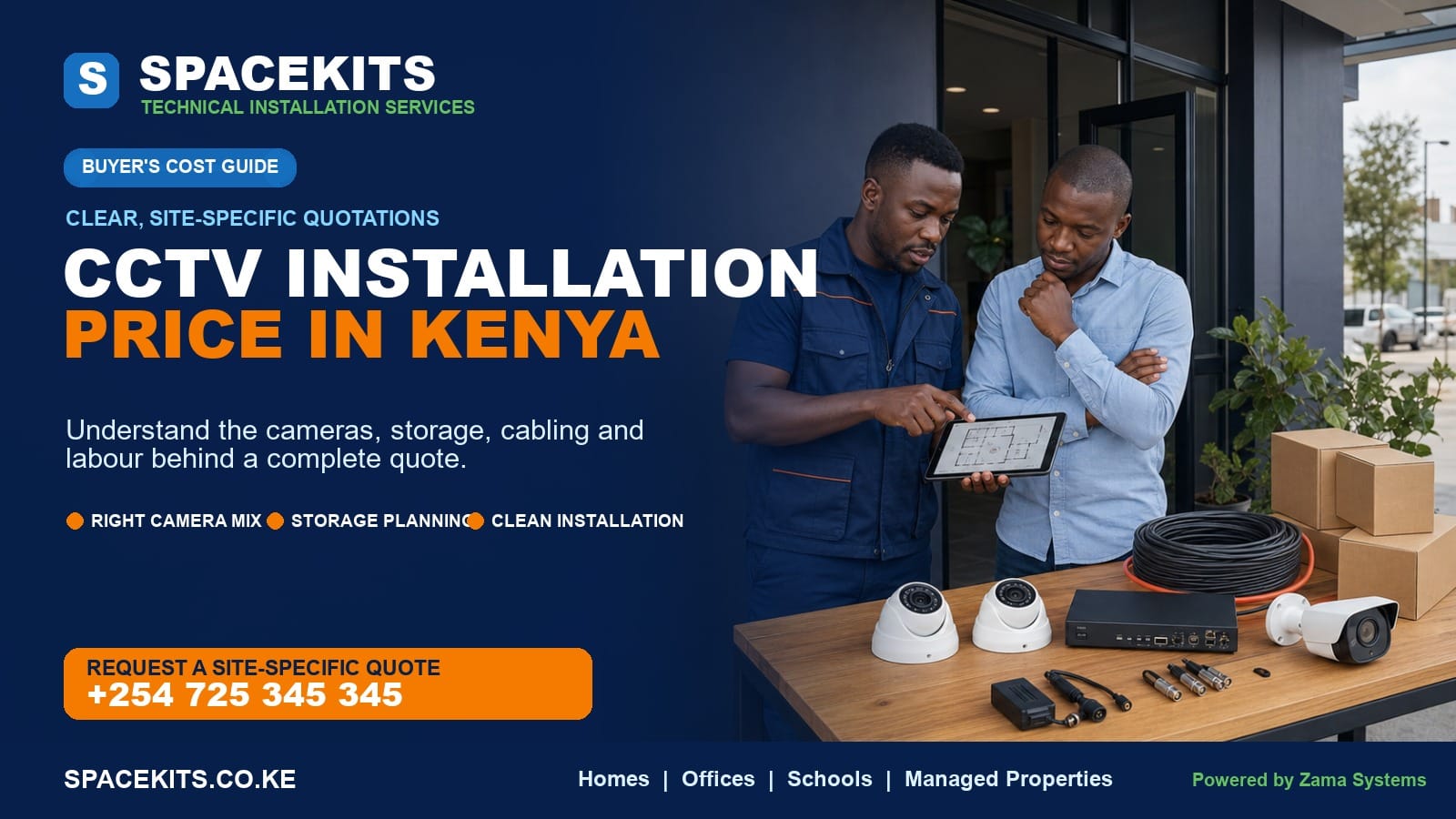
The main components behind CCTV installation cost in Kenya
A complete CCTV system is more than cameras. If a quotation omits one of the core components, the installation may require unexpected additions or operate below the buyer’s expectations. Ask the provider to identify each component and its purpose.
Cameras
Camera cost changes with resolution, sensor and low-light performance, lens, housing, weather protection, supported recording format and specialist features. A fixed-lens indoor camera for a small room is not equivalent to an outdoor varifocal camera intended to cover a distant gate. Brand and product-support availability also affect long-term value.
Recorder
Wired analogue HD systems commonly use a DVR, while IP systems commonly use an NVR. The recorder must support the camera type, chosen image settings and number of channels. It also affects playback, remote viewing, storage expansion and future camera additions. A low-cost recorder that cannot record the cameras at their intended quality is a false saving.
Surveillance storage
The hard drive or other storage determines how much footage can be retained alongside the recording settings. Retention cannot be calculated from capacity alone; it depends on camera count, resolution, frame rate, compression, activity and whether recording is continuous or event-based. The quotation should state the capacity and assumptions, not only say “hard disk included.”
Cabling, connectors and containment
Cable quality and distance influence reliability. The scope may require video cable, network cable, power cable, connectors, junction boxes, trunking, conduit, clips, outdoor protection or poles and brackets. Concealed routes often take more time than surface routes. Long or exposed routes may need a different technical approach.
Power and network equipment
Depending on the system, the installation may need power supplies, a Power over Ethernet switch, data switches, a router connection, a monitor, surge protection or backup power. Mobile viewing requires suitable connectivity, but it should not be confused with cloud recording. Each of these needs should be stated separately.
Professional labour
Labour includes more than fixing cameras to a wall. It covers planning, safe access, route preparation, cable pulling, termination, weather protection, camera alignment, recorder setup, recording tests, remote access and user handover. Difficult roofs, multi-floor buildings, finished ceilings and restricted working hours can change the installation effort.
Four-camera CCTV package planning
A four-camera system is a common entry point for homes, small shops and compact offices. It can cover four important zones, but it cannot automatically cover an entire property. Start with the purpose of each view. A home might prioritise the gate, front door, parking area and rear approach. A shop might prioritise the entrance, till area, customer-floor overview and stock-room access.
The lowest package total may assume basic fixed-lens cameras, a recorder with no spare channels, a small storage drive and a limited length of surface-run cable. A stronger plan might use better night performance at the gate, allow recorder capacity for future expansion, increase storage or provide more protected cabling. These are different systems even though both have four cameras.
Questions to ask about a four-camera quote
- What exact camera specification and lens are included?
- Are all cameras suitable for their indoor or outdoor positions?
- How many channels does the recorder have, and how many remain free?
- What storage capacity is included, and what retention assumptions were used?
- How many metres of cable and what type of containment are allowed?
- Does the quote include mobile viewing, testing and user training?
- Which building, electrical, internet or backup-power work is excluded?
Four cameras can be a sensible first phase if the highest-risk zones are clear and the recorder leaves room to expand. It is less effective when the package is forced onto a property with many entrances simply to meet a low headline budget.
Eight-camera CCTV package planning
Eight-camera plans suit many standalone homes, medium retail spaces, offices and small compounds because they allow the design to separate broad overview views from closer entrance views. The additional cameras also increase storage, cabling, power and installation requirements, so a quote should not be estimated by simply doubling a four-camera total.
For a home, an eight-camera layout might cover the gate, front door, driveway, back door, both side passages and two selected common or perimeter areas. For a business, it might cover two entrances, reception, a customer area, transaction point, stock access, parking and a rear exit. These are examples for planning, not fixed SpaceKits packages.
At eight cameras, recorder capability becomes more important. If the quote uses an eight-channel recorder, all channels may be occupied from the beginning. A recorder with additional capacity costs more but can reduce disruption if cameras are likely to be added. Storage should also be recalculated for eight streams using the proposed settings and activity pattern.
Ask whether cable routes converge neatly at a protected recorder location and whether power or switching equipment can support all cameras. For IP CCTV, the network design must consider switch ports, Power over Ethernet capacity, bandwidth and separation from ordinary user devices. For analogue HD, power distribution and cable quality need the same attention.
Sixteen-camera and larger CCTV system planning
Sixteen-camera systems are often considered for warehouses, apartment common areas, schools, multi-zone offices, larger shops and compounds. The project is no longer just a collection of individual camera runs. It becomes an infrastructure installation with a recorder or server location, cable topology, network capacity, storage design, monitoring workflow and documented user permissions.
A sixteen-camera price can vary widely. Some premises have short routes above accessible ceilings. Others need outdoor trenching or conduit, high-level mounting, several network switches, protected cabinets or work outside business hours. Long-distance or multi-building coverage may require fibre, wireless links or local equipment at different points rather than one simple cable bundle.
Storage is a major design choice at this scale. Higher resolution, longer retention and continuous recording can increase capacity substantially. The client should identify why footage is kept and how quickly incidents are normally discovered. The installer can then model storage using stated assumptions and recommend a practical configuration.
Larger systems also need a handover that goes beyond installing a phone app. Cameras and cables should be labelled, authorised users defined, export procedures demonstrated and system information stored securely. A camera schedule or floor plan can reduce future maintenance cost by showing where every channel is located.
Analogue HD, IP and wireless CCTV price differences
The cheapest equipment type is not automatically the lowest-cost system over its useful life. Compare the complete design, required infrastructure, expansion plan and operational needs.
| System approach | Cost influences | Often suits | Questions before buying |
|---|---|---|---|
| Wired analogue HD | DVR capability, dedicated video and power routes, power supply, camera quality and cable distance | Straightforward homes, shops and offices with practical routes to a central recorder | Does the DVR support the intended recording quality? Is expansion capacity available? |
| IP CCTV | NVR, network cameras, suitable data cable, switches, Power over Ethernet capacity and network design | Scalable business systems, high-detail views and sites with planned network infrastructure | Is the network sized and secured for all streams? Are switch power and bandwidth sufficient? |
| Wi-Fi cameras | Camera power, Wi-Fi coverage, router or access points, local or cloud storage and subscription terms | Selected small or difficult-to-cable locations where signal and power are reliable | What happens when Wi-Fi or internet fails? Is continuous local recording required? |
| Hybrid upgrade | Compatibility testing, retained cabling, replacement recorder, adapters and condition of existing equipment | Properties with some usable infrastructure and a phased replacement plan | Which parts are tested and retained? Will old components restrict the new cameras? |
IP systems can cost more where the network must be built from scratch, yet they may be the stronger choice for expansion or detailed multi-site management. Analogue HD can be cost-effective for a compact central design. Wi-Fi can reduce some data-cable work but may create new costs for coverage, power or cloud services. The survey reveals the real comparison.
How camera specification changes the price
Resolution is one visible number in a camera specification, but buyers should not select on resolution alone. Useful footage depends on how many pixels cover the subject, the lens, distance, lighting, motion and recording settings. A high-resolution camera aimed too widely may provide less identification detail than a correctly framed camera at a controlled entrance.
Low-light performance affects cost because night scenes are difficult. Infrared range claims should be considered alongside the actual scene. Nearby walls, roof surfaces, dust and insects can reflect infrared light. Bright headlights or a lit road behind a dark gate can challenge an ordinary camera. Better sensors, image processing or added lighting may be justified at important points.
A fixed lens is economical where the required angle is known. A varifocal lens allows field-of-view adjustment and can help focus coverage on a gate, corridor or distant zone. Motorised adjustment, optical zoom, pan-tilt-zoom, audio, analytics and specialised housings add cost and complexity. They should only be specified when the operational benefit is clear.
Outdoor protection also matters. The camera housing, bracket, junction box, connectors and cable entry all face the environment. Paying for a suitable outdoor camera while leaving exposed joints unprotected does not create a durable installation. The quotation should include the accessories required for the mounting location.
Storage and recording choices that change the budget
Storage is frequently underspecified in headline packages. A hard drive may be included, but the buyer is not told how long it is expected to retain footage. Ask for the capacity and the settings used for the estimate.
Higher resolution and frame rate generally use more storage. More cameras use more storage. Continuous recording uses more storage than event-based recording in a quiet scene. However, a camera facing a busy road, shop floor or moving trees may trigger event recording for much of the day, so motion recording does not guarantee a particular retention period.
Retention should follow the client’s operational need. A homeowner may discover an incident quickly, while a warehouse discrepancy or apartment complaint may be reported later. Longer retention requires more capacity or lower recording settings, and lowering settings may reduce footage detail. The trade-off should be deliberate.
Local recorder storage, memory-card recording and cloud services are different. Mobile viewing of a local recorder does not mean footage is backed up off-site. Cloud recording can involve supported hardware, bandwidth and recurring fees. If off-site resilience is required, ask for it as a separate line so the ongoing cost is visible.
Cabling and building conditions: the hidden price variable
Cable length is one of the largest differences between apparently similar projects. Four cameras in a small shop may be close to the recorder. Four cameras around a large home compound may require long outdoor runs, wall crossings and protective conduit. Materials and labour both increase.
The desired finish matters. Surface trunking is visible but can be efficient and neat when planned well. Concealed cabling may require accessible ceilings or existing conduits. Chasing finished walls, lifting floors or opening and repairing surfaces is separate building work unless explicitly included. Buyers should agree on the route and finish before comparing totals.
Height and access add cost when safe ladders, scaffolding, lifts or additional personnel are required. Poles and remote structures may need protective enclosures or specialist links. Work in an operating shop, school or office may need scheduling outside normal hours. Travel and site access may also be relevant for projects outside the installer’s normal service area.
A detailed survey prevents a price based on unrealistic cable assumptions. If an initial remote estimate is used, it should identify its cable allowance and any conditions that will be verified on-site.
Power backup, mobile viewing and networking costs
A CCTV system stops recording during a power outage unless every essential component has backup power. That can include cameras, power supplies, recorder, network switches, router and any wireless link. Backup should be sized for the combined load and desired runtime. A generic small UPS may not support the complete system for as long as the buyer expects.
Mobile viewing requires a supported app, secure account configuration and an internet connection at the property. If the router or internet service is unreliable, remote access may be inconsistent even while local recording continues. Improving Wi-Fi inside the building does not automatically improve an internet connection, and a CCTV installer should distinguish the two.
IP CCTV may require a dedicated or logically separated network, suitable switches and enough Power over Ethernet capacity. Multi-building sites may need structured cabling, fibre or point-to-point wireless links. These are legitimate project costs, not optional accessories, when the camera design depends on them.
SpaceKits can assess related Wi-Fi installation, network installation and structured cabling as separately defined services.
How property type changes a CCTV quotation
Homes and apartments
Homes usually prioritise gates, doors, parking and perimeter approaches. Cost changes with compound size, wall finish, detached buildings and whether indoor views are required. Apartment projects may focus on shared entrances, corridors, stairs, parking and service areas, with additional decisions about central monitoring, resident privacy and authorised access.
Shops and restaurants
Retail properties often need entrance, customer-area, transaction, stock and delivery coverage. Long opening hours may increase retention needs. Lighting varies between bright display areas and dim storage rooms. Installation may need to happen outside trading hours, which should be discussed during scheduling.
Offices
Office systems commonly cover reception, entrances, corridors, parking and controlled rooms. Network integration and user permissions may be more important than raw camera count. Finished ceilings can make cable routes simple or difficult depending on access.
Warehouses and yards
Large distances, high roofs, moving stock, loading zones and poor night lighting can require different lenses, mounting equipment and cable infrastructure. A low-cost indoor package is unlikely to meet the same objective. Storage may also grow because many cameras record continuous movement.
Schools, clinics and organisations
These sites may have several buildings, many users, sensitive areas and formal handling requirements. The design should define monitoring purpose, appropriate placement, access permissions and retention. Legal or sector-specific questions should be reviewed by the organisation’s qualified advisers.
Farms and remote sites
Distance, limited power, outdoor exposure and weak connectivity shape the budget. Some locations need solar or backup-power engineering, wireless links or Starlink connectivity. These elements require a site-specific technical design rather than a standard urban package.
Three ways to build a CCTV budget without fake package prices
Instead of choosing an arbitrary online total, build the budget around security priorities. This makes it easier to reduce or phase scope without sacrificing the most important views.
Essential coverage
Fund the points where a person or vehicle must pass: the main gate, primary door, transaction point or controlled stock entrance. Use a recorder that can support later expansion if more zones are already anticipated. Essential coverage should still include suitable storage, cabling and handover.
Balanced coverage
Add context views around parking, reception, common areas, rear access and selected perimeter points. Improve night performance where it affects the security objective. Specify enough storage for the normal period in which incidents are discovered.
Resilient and expandable coverage
Plan spare channels, stronger network infrastructure, appropriate backup power, longer retention, protected equipment locations and documented access. Larger businesses may add central monitoring, multi-site access or separately designed off-site storage. These features should be justified by operational value, not added as vague labels.
A phased plan can control immediate cost. The first phase should still install compatible infrastructure and avoid routes that will need to be rebuilt. Ask the quotation to identify what is included now and what the planned next phase would require.
Cheap CCTV quotes: common exclusions and false savings
A low quotation is not automatically poor, and a high quotation is not automatically good. The risk appears when the scope is too vague to inspect. Look for omissions that change the real delivered value.
- No model or specification: “camera” does not show resolution, lens, outdoor suitability or compatibility.
- No storage detail: “hard disk” does not show capacity or expected retention assumptions.
- No cable allowance: a package may cover only short routes and charge extra after installation begins.
- No containment: trunking, conduit, junction boxes and weather protection may be absent.
- No expansion room: every recorder channel may be filled immediately.
- No configuration scope: mobile viewing, recording schedules, time settings and user permissions may be excluded.
- No power or network assessment: the system may depend on infrastructure the site does not have.
- No handover: users may not know how to find or export footage when an incident occurs.
Another false saving is reusing equipment without testing it. Existing cable and cameras can reduce cost when they are compatible and in good condition. They can also create intermittent faults and limit new equipment. Request a separate line for tested reuse so you understand the trade-off.
How to compare two CCTV quotations line by line
Place quotations side by side and normalise the scope before comparing the totals. If one quote includes storage, protected outdoor connections and mobile setup while another does not, the lower number is not the price of the same result.
- Compare camera brand, model, resolution, lens, low-light capability and indoor or outdoor suitability.
- Compare recorder type, channel count, supported recording quality and spare capacity.
- Compare storage capacity and the stated retention assumptions.
- Compare cable type, estimated distance, connectors, trunking, conduit and outdoor protection.
- Compare power supplies, switches, monitor, router or network work and backup-power scope.
- Compare mounting height, access equipment, drilling, surface repair and working-hour assumptions.
- Compare configuration, phone viewing, user accounts, testing, labelling and handover.
- Compare taxes, transport, delivery, payment milestones and exclusions.
- Compare written after-installation support terms without assuming an unstated warranty or response time.
Ask providers to clarify differences in writing. A detailed quotation protects both the client and installer because it establishes what the approved price covers.
Your CCTV quotation checklist
Send the following information to receive a more useful initial response:
- Property location and type: home, shop, office, apartment, warehouse, school, farm or other site.
- Number of floors, separate buildings, gates and important entrances.
- Priority scenes and the reason each needs monitoring.
- Indoor and outdoor requirements, including approximate distances.
- Existing cameras, recorder, cabling, network and power backup.
- Preferred recording period and whether incidents are usually discovered quickly.
- Need for phone viewing, several users, a control-room monitor or multi-site access.
- Preferred cable finish and any restrictions on drilling or visible trunking.
- Likely future expansion, integrations or additional buildings.
- Photos, plans or a suitable time for an on-site assessment.
For guidance on coverage and camera placement, read CCTV installation in Nairobi. A survey remains the best way to confirm exact cable routes, mounting access, lighting and equipment location.
Maintenance and total cost of ownership
The purchase price is only one part of CCTV cost. Cameras need cleaning and realignment, storage devices eventually wear, power supplies can fail, user access changes and supported software may need updates. A system that is never checked can stop recording unnoticed.
Budget for periodic playback tests and physical inspection. Confirm that each camera records, dates and times are correct, the required retention is available, outdoor joints remain protected and mobile users are still authorised. Review night footage, not only bright daytime images. Vegetation, new signs, shelves or parked vehicles can block views over time.
Commercial clients may prefer planned maintenance because the cost of missing footage can exceed the cost of a routine check. The appropriate frequency depends on site conditions and operational risk. Dusty, busy or exposed sites may need more attention than a small indoor installation.
Keep equipment details, passwords, configuration records and service history securely. This reduces diagnosis time and prevents the owner from becoming dependent on one person’s memory.
How SpaceKits prepares a clearer CCTV proposal
SpaceKits begins with the coverage objective and site conditions. We consider the camera task, system type, recorder capacity, storage, cabling, power, network and handover as one technical scope. The recommendation can then distinguish essential items from optional improvements and future phases.
We do not use fabricated price claims, testimonials, certifications or warranties to force a sale. Equipment availability and project conditions can change, so the current quotation should be the source of truth for products, price, schedule and commercial terms. Ask questions until every important line is understood.
SpaceKits technical services, powered by Zama Systems.
Get a CCTV installation quote based on your property
Send SpaceKits the property location, priority areas, approximate camera count and whether you need outdoor coverage, night viewing, phone access, power backup or reuse of existing equipment. We can use that information for an initial scope and confirm the final recommendation after the appropriate assessment.
Do not choose only by the lowest headline total. Choose a documented system that covers the right places, records at the expected quality and gives authorised users a clear way to retrieve footage.
Frequently asked questions about CCTV installation prices in Kenya
How much does CCTV installation cost in Kenya?
The cost depends on camera specification and count, recorder, storage, cable distance, mounting access, power, network needs and installation finish. An accurate quote should identify these items and follow a site assessment or clearly stated assumptions. A generic online package is not a final price for every property.
Why can two four-camera CCTV quotes be very different?
They may use different camera quality, lenses, recorder capability, storage, cable allowances and accessories. One may include outdoor protection, mobile viewing and handover while another excludes them. Compare the itemised scope before comparing the totals.
Is an eight-camera package simply twice the price of four cameras?
Not necessarily. Recorder size, storage, power supplies, switches, cable routes and labour do not always scale in a straight line. An eight-camera design may also use different camera types at different locations. It needs its own calculation.
Does a CCTV package price include a hard drive?
Some packages do and some do not. The quotation should state the storage capacity and the assumptions used to estimate footage retention. Do not assume that “complete package” includes suitable storage unless it is written.
Does mobile viewing increase the installation cost?
It may be included as configuration when the recorder supports it and the site has suitable internet. Additional network work, router changes, access points, user setup or cloud services may cost extra. The quote should separate these items.
Is wireless CCTV cheaper than wired CCTV?
Not always. Wireless cameras still need power and reliable Wi-Fi. Weak coverage may require network upgrades, and some products use paid cloud storage. Wired systems require cable labour but can provide more predictable continuous recording. Compare the whole design.
Can I reduce cost by reusing existing cameras and cables?
Yes, if testing confirms that the equipment is compatible and in good condition. Reusing damaged cable, unsupported cameras or an undersized power supply can create faults and restrict the new system. Ask the installer to state what is retained and what limitations remain.
How can I lower the budget without losing important coverage?
Prioritise gates, doors, transaction points and other choke points, then phase lower-priority overview areas. Choose a recorder and infrastructure that can support planned expansion. Do not remove storage, suitable cable or essential installation work merely to preserve a camera count.
Should backup power be included in the CCTV quote?
Include it when recording during outages is important. The backup must support cameras, recorder and required network equipment for the desired runtime. It should be sized from the actual load and listed separately so its scope is clear.
What should I send SpaceKits for a CCTV quotation?
Send the property type and location, priority areas, floors and buildings, existing equipment, retention needs, mobile-viewing requirements, desired cable finish and any plans for expansion. Photos or a simple plan help with initial scoping, while an assessment confirms the final design.
Need Starlink Installation or Network Optimization?
We help homes, offices, apartments, and businesses with Starlink installation, WiFi coverage improvement, and professional setup in Kenya.
Request Installation Chat on WhatsApp