



Need Starlink Installation or Network Optimization?
We help homes, offices, apartments, and businesses with Starlink installation, WiFi coverage improvement, and professional setup in Kenya.
Request Installation Chat on WhatsApp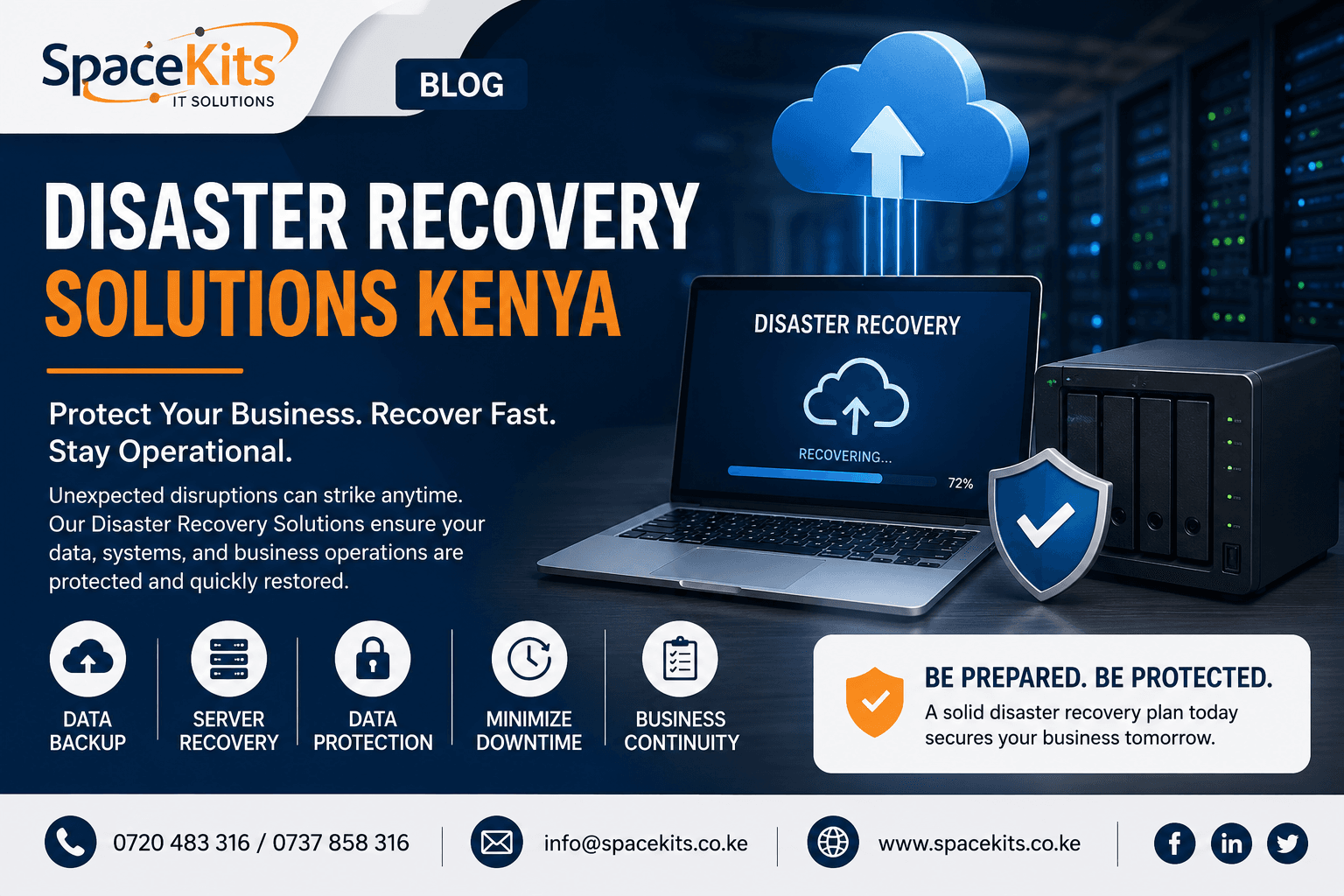
Introduction
Every business depends on technology to keep operations running smoothly. From customer records and financial data to emails, applications, and business systems, organizations rely on digital information every day. Unfortunately, unexpected events such as cyberattacks, hardware failures, power outages, human error, floods, fires, or ransomware attacks can bring operations to a standstill in a matter of minutes.
Talk to Spacekits
Need Starlink help for your home or business?
Talk to Spacekits before you buy or book installation. We help with kit supply, mounting, activation, router placement, WiFi coverage, and written quotes.
For businesses across Kenya, these disruptions can result in lost revenue, damaged customer trust, regulatory issues, and costly downtime. This is why investing in professional Disaster Recovery Solutions Kenya is no longer optional—it is an essential part of modern business risk management.
Disaster recovery (DR) ensures that your business can quickly recover its critical systems and data after an unexpected incident. Instead of spending days or weeks rebuilding your IT infrastructure, a well-designed disaster recovery plan enables you to restore operations quickly and continue serving customers with minimal interruption.
At SpaceKits, we help businesses across Kenya develop reliable disaster recovery strategies that protect valuable data, reduce downtime, and ensure business continuity. Whether you operate a small office, a corporate enterprise, a healthcare facility, a school, or a retail business, our disaster recovery solutions are designed to keep your organization resilient in the face of unexpected challenges.
What Are Disaster Recovery Solutions?
Disaster recovery refers to the processes, technologies, and procedures used to restore IT systems, applications, and business data after a disruption.
Professional s include planning, backup management, infrastructure recovery, cloud recovery, cybersecurity measures, and ongoing testing to ensure that businesses can recover quickly when disaster strikes.
A comprehensive disaster recovery strategy typically covers:
- Data backups
- Server recovery
- Cloud disaster recovery
- Network restoration
- Application recovery
- Virtual machine recovery
- Email recovery
- Business continuity planning
- Recovery testing
The goal is to minimize downtime and restore normal operations as quickly as possible.
Why Every Business Needs a Disaster Recovery Plan
Many organizations assume disasters are unlikely until they experience one. Unfortunately, unexpected events happen more often than many business owners realize.
Common causes of IT disasters include:
- Hardware failure
- Hard drive crashes
- Cyberattacks
- Ransomware infections
- Human error
- Accidental file deletion
- Power outages
- Floods
- Fire damage
- Theft of IT equipment
- Network failures
- Software corruption
Without a disaster recovery plan, recovering from these events can be slow, expensive, and sometimes impossible.
Benefits of Professional Disaster Recovery Solutions Kenya
Minimized Downtime
A disaster recovery plan enables businesses to restore operations quickly, reducing productivity losses and financial impact.
Protection Against Data Loss
Automated backups ensure that important business information is protected and recoverable.
Business Continuity
Customers expect businesses to remain available even during unexpected disruptions.
Disaster recovery helps maintain operations and customer confidence.
Improved Cybersecurity
Recovery solutions often include protection against ransomware, malware, and other cyber threats.
Regulatory Compliance
Many industries require secure data protection and recovery procedures to meet regulatory obligations.
Peace of Mind
Knowing that your systems and information can be restored provides confidence for business owners and management teams.
Components of a Disaster Recovery Strategy
Data Backup
Reliable backups are the foundation of every disaster recovery plan.
Backups should include:
- Business documents
- Databases
- Emails
- Financial records
- Customer information
- Virtual machines
- Server configurations
Backups should be automated and verified regularly.
Cloud Backup
Cloud storage provides an additional layer of protection by keeping backup copies off-site.
Benefits include:
- Automatic synchronization
- Geographic redundancy
- Secure encryption
- Remote accessibility
- Faster recovery
Cloud backup reduces the risk of losing data due to local disasters.
Server Recovery
Business servers host essential applications and files.
Professional disaster recovery includes:
- Bare-metal recovery
- Virtual server recovery
- Image-based backup
- Rapid restoration
- Hardware replacement planning
These measures ensure critical services can be restored quickly.
Network Recovery
Business operations often depend on stable network connectivity.
Recovery plans include restoring:
- Routers
- Switches
- Firewalls
- Wi-Fi systems
- VPN services
- Internet connectivity
Proper documentation speeds up network restoration.
Application Recovery
Many organizations rely on specialized software for accounting, inventory, healthcare, education, or customer management.
Recovery plans prioritize restoring these applications to minimize business disruption.
Disaster Recovery vs Business Continuity
Although closely related, disaster recovery and business continuity are different concepts.
Disaster Recovery focuses on restoring IT systems after an incident.
Business Continuity focuses on ensuring that the organization continues operating throughout and after the disruption.
Together, they create a comprehensive resilience strategy.
Recovery Objectives
Two important concepts in disaster recovery planning are:
Recovery Time Objective (RTO)
The maximum acceptable time to restore operations after an outage.
For example, a business may set an RTO of four hours.
Recovery Point Objective (RPO)
The maximum acceptable amount of data that can be lost.
For example, if backups occur every hour, the RPO is one hour.
These objectives help determine the appropriate backup and recovery strategy.
Why Choose SpaceKits?
SpaceKits provides comprehensive Disaster Recovery Solutions Kenya designed to protect businesses against unexpected disruptions.
Our services include:
- Disaster recovery planning
- Automated cloud backup
- Server backup and recovery
- Microsoft 365 backup
- Google Workspace backup
- Ransomware recovery
- Business continuity planning
- Disaster recovery testing
- Infrastructure recovery
- Ongoing monitoring and support
We tailor every recovery solution to the unique operational needs of each client.
Industries We Serve
Our disaster recovery services support:
- Corporate offices
- Schools and universities
- Hospitals and clinics
- Hotels
- Financial institutions
- Manufacturing companies
- Retail businesses
- Government organizations
- NGOs
- Logistics companies
- Professional service firms
- Technology companies
Frequently Asked Questions
What is disaster recovery?
Disaster recovery is the process of restoring IT systems, applications, and data after unexpected disruptions such as cyberattacks, hardware failures, or natural disasters.
How often should backups be performed?
Critical business data should be backed up automatically according to business requirements. Many organizations perform backups daily or even hourly.
Can cloud backups replace local backups?
The best practice is to use both. Local backups provide fast recovery, while cloud backups protect against site-wide disasters.
How often should disaster recovery plans be tested?
Businesses should test their disaster recovery procedures at least once or twice a year to ensure they remain effective.
Does SpaceKits provide disaster recovery planning?
Yes. We design, implement, test, and maintain disaster recovery solutions tailored to businesses across Kenya.
Conclusion
Unexpected disruptions can happen to any organization, but they don’t have to become business-ending events. Professional Disaster Recovery Solutions Kenya help businesses prepare for the unexpected by protecting critical data, reducing downtime, and ensuring rapid recovery.
At SpaceKits, we combine proven backup technologies, cloud solutions, cybersecurity expertise, and business continuity planning to help organizations build resilient IT environments. Whether you need disaster recovery for a single office or multiple business locations, our experienced team is ready to help.
Contact SpaceKits today and let us build a disaster recovery strategy that keeps your business protected, resilient, and ready for whatever comes next.
Need Starlink Installation or Network Optimization?
We help homes, offices, apartments, and businesses with Starlink installation, WiFi coverage improvement, and professional setup in Kenya.
Request Installation Chat on WhatsApp