
Need Starlink Installation or Network Optimization?
We help homes, offices, apartments, and businesses with Starlink installation, WiFi coverage improvement, and professional setup in Kenya.
Request Installation Chat on WhatsAppProfessional rooftop planning, mounting, cable routing and handover
Talk to Spacekits
Need Starlink help for your home or business?
Talk to Spacekits before you buy or book installation. We help with kit supply, mounting, activation, router placement, WiFi coverage, and written quotes.
Starlink Roof Installation Kenya
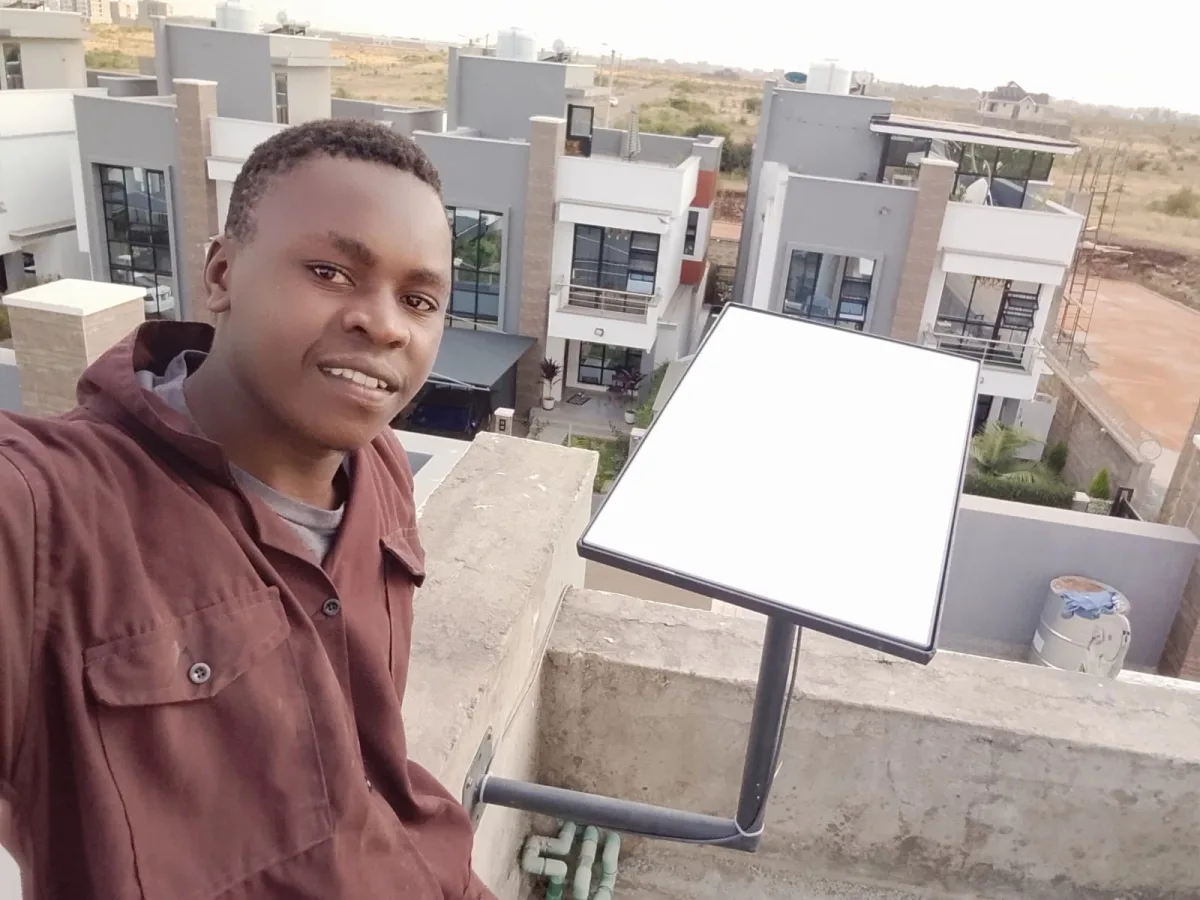
Starlink Roof Installation Kenya customers can trust starts with a clear-sky assessment and a safe mounting plan, not with drilling the first visible roof sheet. SpaceKits helps homeowners, landlords, businesses, schools, hospitality properties, farms and organisations install customer-owned Starlink equipment on suitable roofs across Kenya. We review the kit, property, access route, possible obstructions, mounting surface, cable path and indoor Wi-Fi requirement before agreeing on the work.
A roof can provide a useful field of view, but every roof is different. Concrete slabs, stone-coated tiles, mabati, clay tiles, commercial metal roofing and high apartment rooftops require different access and fixing decisions. The right installation protects people, the building and the equipment while leaving the Starlink terminal with a suitable view of the sky. It also routes the cable without tight bends, exposed trip hazards or an unfinished wall opening.
Request a roof-installation assessment: send your county or town, exact location pin, property type, kit model, roof photographs and a photo of all equipment in the box. Send the roof details to SpaceKits on WhatsApp or call +254 725 345 345.
Independent-provider notice: SpaceKits is an independent Kenyan technical installation provider. We are not Starlink or SpaceX, and we do not claim endorsement, accreditation or authority to make decisions about Starlink accounts, subscriptions, coverage, billing, warranties or support cases.

When rooftop installation makes sense for a Kenyan property
Starlink needs a suitable view of the sky. Trees, nearby buildings, parapets, water tanks, lift structures, chimneys, billboards and even a higher part of the same roof can interrupt that view. The official Starlink application includes a Check for Obstructions tool that should be used from approximately the intended terminal position. Testing more than one possible location is valuable because the most convenient fixing point is not always the position with the clearest field of view.
A roof is often considered because it rises above compound walls and some nearby vegetation. It may also create a shorter path to an upstairs router location. That does not make every roof position automatically suitable. A terminal placed under the overhang of a taller roof, beside a large tank or immediately behind a parapet can still experience interruptions. A high position may solve one obstruction while creating difficult access, a long cable route or unnecessary exposure to wind.
The goal is therefore not simply to put the equipment as high as possible. It is to select the lowest safely maintainable position that gives the required sky view and supports a secure installation. Keeping future maintenance in mind matters. A terminal that can only be reached with improvised climbing becomes expensive and risky whenever the cable, mount or roof needs inspection.
Homes and maisonettes
On a detached house, the options may include a wall-mounted pole near the eaves, a suitable roof mount, a pole secured to a structurally appropriate part of the building, or another elevated point in the compound. The decision should consider the roof material, prevailing exposure, tree growth and the rooms that need Wi-Fi. A neat route to a central indoor router position can be more useful than the shortest route to a corner bedroom.
Apartments and multi-tenant buildings
Apartment rooftops are shared spaces. A tenant should obtain the landlord’s or property manager’s approval before drilling, attaching equipment or routing cable through common areas. Roof access, cable ducts, exterior elevations, safety rules and the responsibility for future removal should be agreed in advance. In Nairobi and other dense towns, neighbouring towers can affect the sky view even when the rooftop itself seems open.
Schools, lodges, offices and commercial sites
Commercial roofs can offer open space, but they may also contain solar arrays, HVAC equipment, tanks, antennas and restricted maintenance routes. Installation must avoid blocking drainage, walkways or access to other services. The Starlink connection and the internal network should be treated as related but separate scopes. A good rooftop link does not by itself provide Wi-Fi across classrooms, hotel rooms, a warehouse or several office floors.
Farms and rural properties
Rural sites may have fewer buildings but more mature trees, long internal distances and irregular power. A house roof can work, but a secure wall or pole position may be easier to maintain. The assessment should consider seasonal tree growth, wind, livestock, farm machinery and how internet will reach an office, workers’ quarters, gatehouse or secondary building. Where several buildings need service, the local network design must be planned beyond the Starlink installation.
What SpaceKits checks before a Starlink roof installation
A professional assessment reduces surprises. Start by sending clear photographs from ground level showing all sides of the building, roof slopes, surrounding trees and neighbouring structures. Add close photographs of the proposed access point if it can be viewed safely. Do not climb onto a roof simply to take pictures for a quotation. State the number of floors, roof material, access method and whether the building has a roof hatch, balcony or stable ladder position.
SpaceKits also asks for the exact hardware model. Starlink generations use different terminals, cables, power arrangements and mounting interfaces. A bracket bought for one model may not fit another. The supplied kickstand is useful for appropriate setup and testing, but the permanent mounting decision should follow the guidance for the particular kit and the conditions at the property.
Sky-view assessment
The official obstruction tool should be used near the proposed height and perspective. A ground-level scan cannot reliably represent the view several metres above. On site, the installer compares likely points and notes trees, poles, roof ridges, tanks and planned developments. Some obstructions may be removed responsibly, while others make relocation the better answer. Cutting a mature tree or altering a neighbouring structure is not part of normal installation work.
Roof condition and access
An installer is not a structural engineer or roofing contractor. Visible signs such as cracked tiles, corroded sheets, weak fascia, water damage, unstable ladders or an unsafe pitch can require a revised plan or specialist review. SpaceKits may decline to walk on fragile roofing or postpone work until safe access is provided. Completing an unsafe job quickly is not professional service.
Mounting surface
The team identifies what will actually carry the installation. Decorative cladding, a thin sheet edge or a loose timber member is not automatically a suitable fixing surface. Concrete, masonry, timber framing and metal structures require appropriate fasteners and methods. Where the exact structure is hidden, a conservative plan or local building professional may be needed.
Cable route
The route is measured from the terminal to the indoor equipment, including vertical drops, corners and service loops. The cable should not be stretched to its limit, crushed through a window, joined casually or bent sharply. The installer considers UV exposure, rainwater, sharp edges, hot roof surfaces, foot traffic and the wall-entry position. Concealed routing through ceilings or ducts may need additional time, access and containment.
Power and indoor network
A protected, dry and ventilated power position is needed for the relevant equipment. The router should be placed for useful Wi-Fi coverage rather than hidden beside the cable entry by default. Reinforced concrete, thick masonry, metal roofing and multiple floors can weaken indoor coverage. If the property needs mesh units, wired access points, Ethernet, a firewall connection or backup power, those requirements belong in the scope before work starts.
Installation planning for common roof types in Kenya
Flat concrete roofs
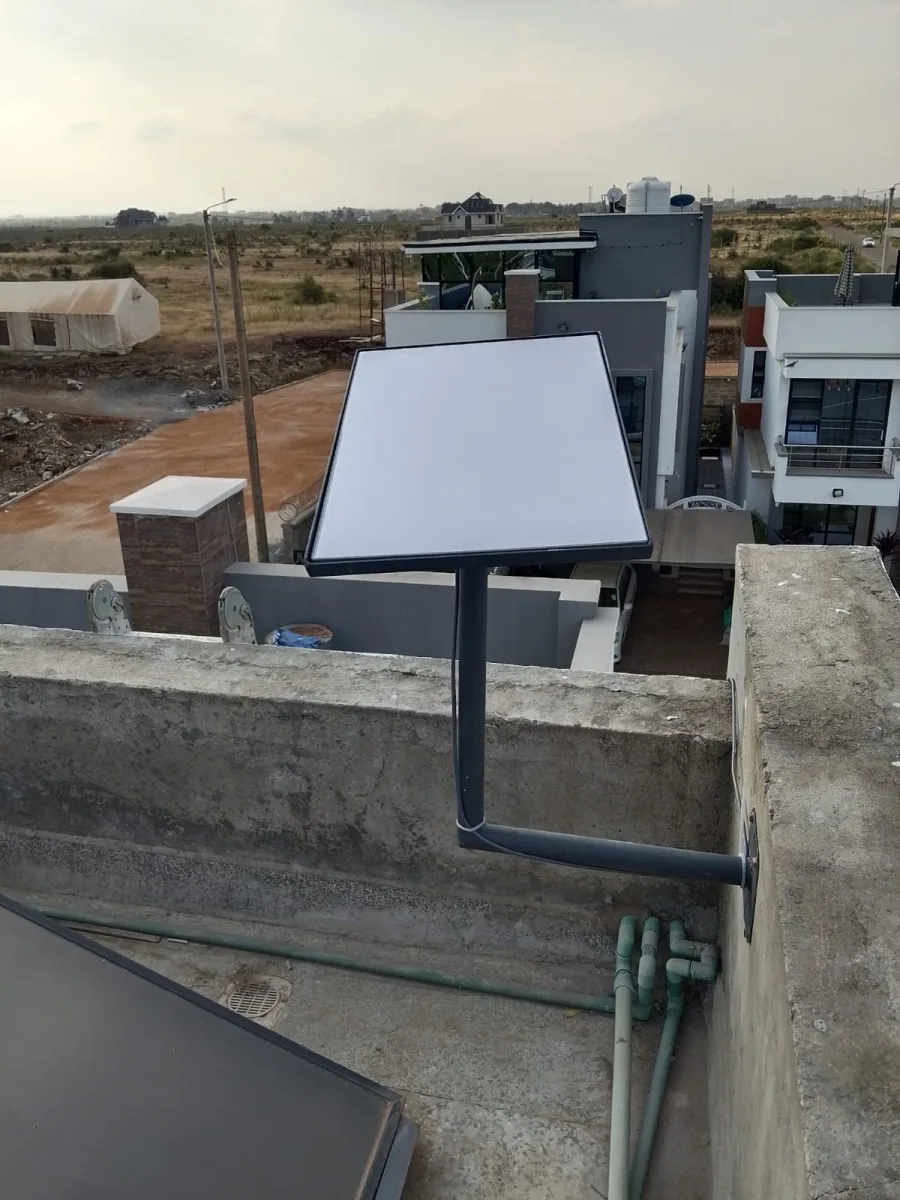
Flat concrete roofs are common on apartments, offices and some homes. They may offer secure stair access and several mounting surfaces, but they still need careful planning. A mount should not obstruct drainage or damage waterproofing. Drilling into a slab or parapet must be agreed with the owner, and any penetration requires an appropriate finish. Freestanding or weighted approaches should not be improvised without considering wind loading and the manufacturer’s installation guidance.
Water tanks and lift rooms can dominate a flat roof. Positioning the terminal beside them for convenience can create an obstruction. The installer should also leave room for tank cleaning, solar maintenance and safe movement. Cables should follow a controlled route and not lie loose across a walkway where they can be damaged.
Mabati and commercial metal roofs
Metal roofs range from small residential sheets to long-span warehouse systems. Walking on the wrong point can dent a sheet or cause a fall. A fixing that appears tight at installation may loosen if it relies only on thin sheet material. The mounting plan must consider the underlying structure and the roof manufacturer’s constraints. On industrial buildings, specialist access or coordination with the facility’s roofing contractor may be appropriate.
Metal heats in the sun, has sharp edges and can transmit movement. Cable routes should be protected from abrasion and kept away from hot or moving contact points. Indoor Wi-Fi can also behave differently in metal-clad spaces, so an access point or wired distribution plan may be needed even when the satellite link is good.
Clay, concrete and stone-coated tiles
Tiled roofs require care because individual units can crack under weight or when lifted incorrectly. Fixing through a tile without a suitable method can create a leak. The installer should avoid claiming that every tiled roof can accept the same bracket. The supporting structure, tile profile, underlay and access route all affect the decision. If roofing work is needed, a competent roofer may need to participate.
A wall or fascia-adjacent mounting plan may sometimes reduce disturbance to the roof covering, but the wall or fascia must itself be suitable. The right answer is property-specific. Customers should disclose existing leaks or recent roof work before installation.
Steep, high or fragile roofs
Height and pitch change the risk. A two-storey house with a steep tiled roof may require more than a household ladder. A high-rise, church, warehouse or lodge may require specialist access equipment, an additional technician, a lift or a safer alternative mounting location. SpaceKits will assess whether the requested job falls within the available safe-access scope. Where it does not, the quotation can be revised or the work declined.
Thatched, asbestos-containing or unusual roofs
Routine drilling or walking should not be assumed on unusual materials. Suspected asbestos-containing sheets require specialist management and are outside ordinary installation work. Thatched roofs need a fire-, weather- and structure-aware approach from relevant professionals. The terminal may be better placed on a separate pole or suitable adjacent structure. The customer’s safety and the building’s integrity come before a convenient mount.
Choosing a mount for wind, access and the exact Starlink model
Mount compatibility is model-specific. Official Starlink guidance notes that mounts intended for one hardware family may not work with another. The customer should send the label, terminal and connector photographs before buying a bracket. SpaceKits can check the physical requirement and quote compatible hardware separately where needed, but final product availability and official accessory specifications remain subject to the manufacturer or seller.
A mount performs several jobs. It holds the terminal in the required position, transfers wind forces into an appropriate structure, keeps the equipment away from avoidable obstructions and allows the cable to leave without being crushed. It should also permit future inspection. Decorative appearance matters, but it cannot replace structural suitability.
Roof, wall and pole options
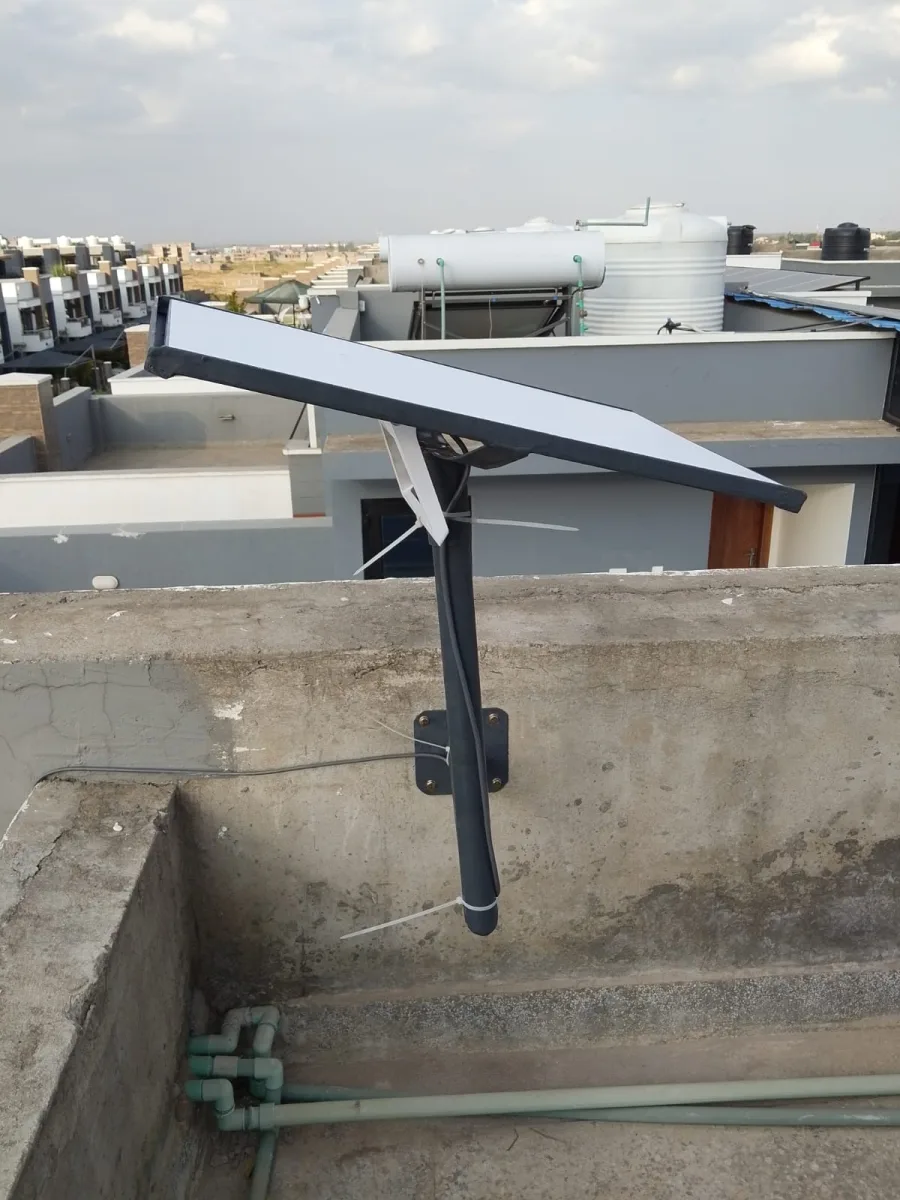
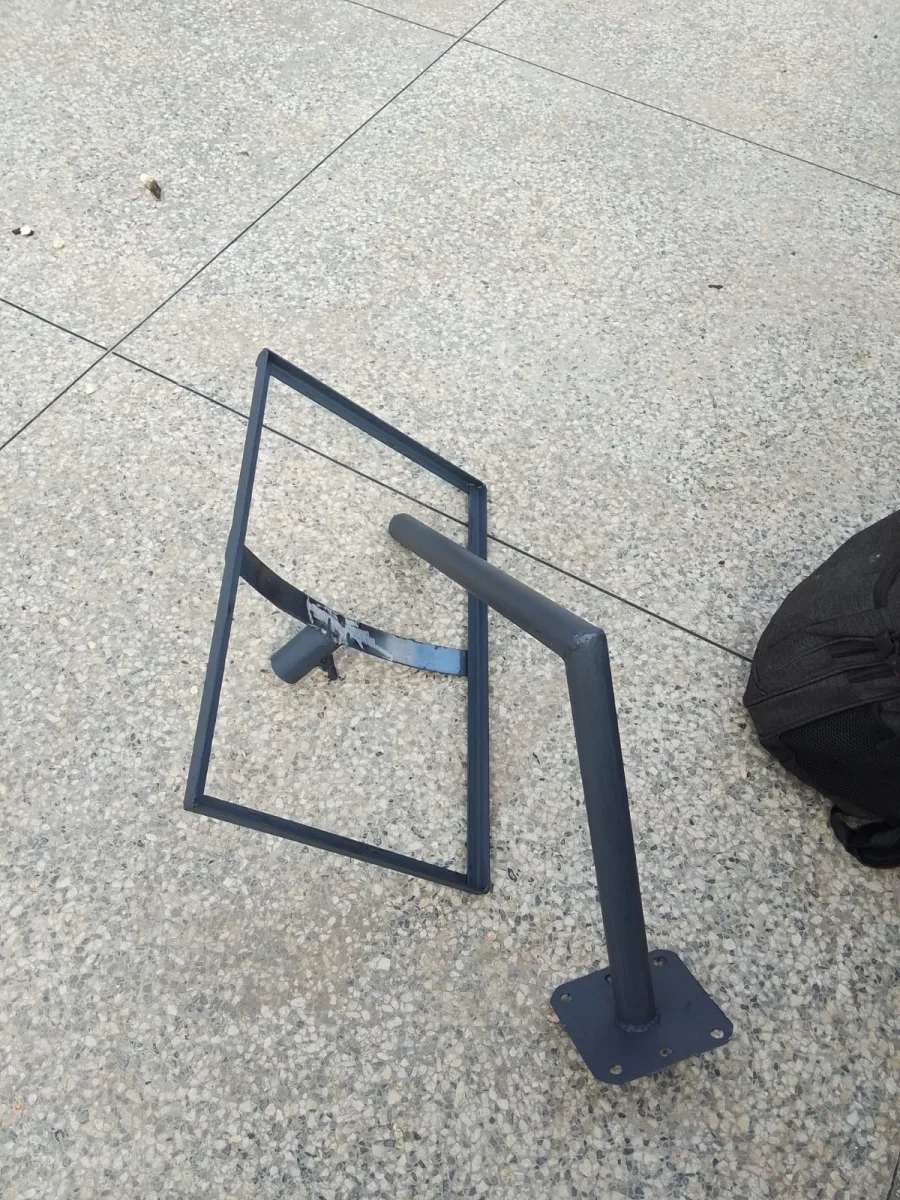
A dedicated roof mount can be suitable where the roof structure and waterproofing method are understood. A wall mount near the roofline may provide a clear view while reducing roof penetrations. A pole can lift the terminal above a parapet or roof ridge, but an excessively tall unsupported pole creates leverage and movement. Guying, bracing or structural design may be needed for taller solutions.
The official hardware guidance should be followed for the terminal’s intended orientation. A customer should not assume that a flat-panel terminal can be attached vertically merely because a wall is available. The wall mount or adapter is designed to hold the unit in an appropriate operating position; the terminal itself should not simply be screwed flat against a wall.
Coastal and exposed locations
Mombasa, Kilifi, Kwale and other coastal sites can expose external hardware to salt-laden air. Highland ridges, open plains and tall urban roofs can experience strong gusts. The scope should consider corrosion-resistant components, appropriate fasteners, pole strength, support and inspection intervals. No installer can promise that a mount will survive every extreme weather event, but a reasoned design is better than an unbraced pole chosen only for height.
Avoiding improvised mounting
Loose stones, water-filled containers, thin pipes, timber offcuts and cable ties are not reliable permanent roof mounts. A temporary test can help confirm connectivity, but it should not quietly become the final installation. Wind can move equipment, damage the cable or create a falling-object hazard. SpaceKits separates temporary testing from permanent mounting in the quotation and handover.
Cable routing, building entry and weather protection
The cable is part of the system, not a disposable wire. Official troubleshooting guidance tells customers to inspect connections for damage, kinks and weather exposure and recommends official compatible cables. An installation should therefore protect the supplied cable instead of forcing it through a route that will damage it. Third-party joins or improvised repairs can create compatibility, reliability and warranty problems.
Outdoor route
The cable should be supported at sensible intervals, kept away from sharp sheet edges and protected where it can be stepped on, pulled or struck. It should not be tensioned between the terminal and the wall. A small service allowance supports maintenance without leaving large loops to flap in the wind. Where conduit or trunking is requested, its dimensions, bends and access points must suit the actual connector and cable.
Drip management and wall entry
Rainwater should not be encouraged to follow the cable indoors. The route and entry detail need a weather-aware finish. A random upward-sloping hole, unsealed gap or crushed cable under a window is not a completed job. The installer should agree where drilling is allowed, check for obvious electrical or plumbing risks and use an appropriate sealing method for the building surface.
Indoor finish
Inside, the route should avoid doors, hot equipment, wet areas and places where furniture will crush it. Router and power equipment need ventilation and a stable surface. If a cable must cross a visible finished area, the customer can choose a quoted containment option rather than discovering an exposed route after drilling has begun.
Long and complex routes
A long cable requirement should be identified before mounting. Extension choices must be compatible with the exact hardware and official guidance. Running through several floors, underground ducts or between buildings is not a standard short installation. Those paths may require a network redesign, an approved longer cable, fibre or Ethernet distribution beyond the Starlink equipment. SpaceKits will distinguish physical terminal installation from wider structured cabling.
How SpaceKits completes a roof-installation project
- Remote brief: You send the location pin, county, property type, roof and kit photographs, access details and required Wi-Fi coverage.
- Compatibility screening: We identify the hardware generation, supplied components and likely mounting or cable requirements.
- Survey decision: A simple site may be quoted conditionally from evidence. A high, restricted, fragile or commercial roof may require an on-site survey before a final scope.
- Written quotation: Labour, mount, fasteners, cable protection, travel, network extras, access assumptions and exclusions are separated clearly.
- Permission and scheduling: The customer confirms landlord, management or facility approval and ensures roof access is available.
- Final location check: The installer reviews obstructions and confirms that the proposed point remains safe and suitable.
- Mount and route: The approved support is fitted, the terminal installed and the cable routed and protected as agreed.
- Customer-led setup: The account owner retains login and payment credentials while the team assists with physical connection and application checks.
- Testing: Connection status, obstruction information and agreed Wi-Fi points are reviewed. Results can vary with service conditions and are not a fixed-speed guarantee.
- Handover: The customer sees the mount, route, equipment position, limitations and recommended follow-up actions.
Customers who already own their equipment can read the Nairobi installation-only guide. Those comparing alternative supports can review Starlink installation with a mounting stand. SpaceKits also provides a broader Starlink installer service in Nairobi.
Service scope, limitations and roof-installation quotation factors
A standard scope can include site review, a suitable installation position, fitting of an agreed compatible mount, terminal placement, careful routing of the supplied cable, a finished agreed entry, indoor equipment placement, basic application-assisted setup and connection testing. The exact inclusions appear in the quotation. The Starlink kit, official plan, mount, extended cable, trunking, mesh system, backup power, lift equipment and structural or roofing work are not assumed to be included unless listed.
Quotation factors include the county and travel distance, property height, roof pitch and material, access method, crew requirements, mounting hardware, cable length, containment finish, drilling complexity, parking or security procedures, Wi-Fi coverage and timing restrictions. A bungalow with safe access and a supplied compatible mount requires a different scope from a hotel roof, apartment block or long-span warehouse.
SpaceKits does not publish one invented fixed price for every Kenyan roof. Photographs can support a preliminary estimate, while complex properties may require a survey. A useful quote states assumptions and what could change the amount. For a wider explanation, see the Starlink installation cost in Kenya guide.
What installation cannot guarantee
Physical installation cannot activate a kit that is damaged, incomplete, account-locked, improperly transferred or unsupported at the customer’s intended service address. SpaceKits cannot change network capacity, plan eligibility, subscription pricing, billing, official support decisions or hardware warranty outcomes. Internet performance varies with obstructions, service conditions, network demand, weather, the customer plan and local Wi-Fi design.
We do not provide structural engineering, asbestos handling, major electrical work, roof reconstruction, waterproofing of existing leaks or tree removal as part of a normal installation. Unsafe work may be paused or declined. If another professional is needed, the customer should arrange that work before the installation proceeds.
What to inspect before accepting the roof-installation handover
Begin with the mount. It should be attached to the agreed suitable structure, and the terminal should sit in the intended orientation without obvious uncontrolled movement. Confirm that the mount does not block drainage, interfere with roof maintenance or create an avoidable trip hazard. Ask how the installation can be accessed for future inspection.
Follow the cable visually. Look for protection at sharp edges, sensible support, no tight bends and no section pulled under tension. Check the wall entry from outside and inside. There should not be an open hole that invites water or insects. Indoors, power equipment should be dry, ventilated and safely arranged.
Use the customer’s official application to check status and available obstruction information. The official support material explains that a mature obstruction map can take time to develop, so an immediate view may not tell the whole story. Test the internet at agreed indoor points and distinguish satellite-link performance from Wi-Fi coverage. One strong reading beside the router does not prove coverage throughout a large house.
Keep your invoice, quotation and installation photographs. Record the kit model and where the cable runs before future renovations. Retain control of your Starlink account and payment details. Contact SpaceKits about installation workmanship and use the official Starlink support route for account, billing, platform or manufacturer-controlled hardware decisions.
Keep a simple roof-installation decision record
Before work begins, save four photographs: the selected terminal position, the wider sky view, the planned outdoor cable route and the indoor equipment area. Add the mount description, kit model and access method to the quotation. This small record helps the customer, installer and future roofer understand why the position was chosen. It is especially useful after tree growth, solar-panel work, painting or a roof renovation changes the surroundings.
After handover, add photographs of the completed support, cable clips, wall entry and router position. Record any limitation that was accepted, such as one distant room requiring a later mesh assessment. The record does not create a performance guarantee, but it prevents future contractors from moving the terminal casually or cutting a cable whose route is forgotten.
Book Starlink roof installation anywhere SpaceKits can safely serve
For the quickest assessment, send one WhatsApp message containing the county, nearest town or estate, a Google Maps pin, property type, number of floors, roof material, clear exterior photos, kit model and components, any mount already purchased and the rooms or buildings that need internet. Explain whether you own the property and whether access approval is already available.
SpaceKits will review what can be assessed remotely and tell you whether a survey is needed. The team will not promise a universal price, a guaranteed activation or a fixed speed from one photograph. You will receive a scope based on the site evidence, with optional accessories and network work separated.
WhatsApp SpaceKits for a location-aware roof quotation or call +254 725 345 345.
Frequently asked questions about Starlink roof installation in Kenya
1. Must Starlink always be installed on the roof?
No. A roof is one possible location. A suitable wall, pole or open ground position may provide a clearer sky view and safer maintenance. SpaceKits compares the field of view, structure, cable route and access before recommending a position.
2. Can SpaceKits install a Starlink kit that I bought elsewhere?
Yes, subject to hardware inspection, compatibility, site suitability and an agreed scope. Send photographs of the label, terminal, router or power unit, connectors, cable and any mount. Account ownership, transfer and activation remain the customer’s responsibility through official channels.
3. How much does Starlink roof installation cost in Kenya?
The cost depends on location, roof height and material, safe access, mount, cable route, containment, crew needs and network extras. SpaceKits provides a site-based quotation instead of claiming one fixed amount for every building.
4. Can you install on mabati or tiled roofs?
Potentially, but not with one universal method. The team must assess the underlying structure, roof condition, safe access and waterproofing implications. Fragile, steep or damaged roofs may need a different location or specialist roofer.
5. Do I need a permanent mount?
A compatible permanent mount is recommended where it improves long-term stability, cable protection and sky view. The supplied temporary or kickstand setup may be useful for testing, but the final choice depends on the exact kit and site. Mounts are model-specific.
6. Will drilling cause my roof to leak?
Any roof penetration must be planned and finished appropriately, but no responsible installer can promise that every roof can be drilled safely. Existing roof condition, material and waterproofing matter. Some sites are better served by a wall, pole or roofer-approved solution.
7. Can the Starlink cable be extended or joined?
Do not assume a casual join is safe or compatible. The required route should be measured first and matched to official compatible cable options for the exact hardware. Improvised joins can cause connection, weatherproofing and warranty problems.
8. Does roof installation guarantee fast internet?
No. Good positioning and installation remove avoidable physical problems, but performance varies with the plan, network conditions, obstructions, weather, devices and local Wi-Fi. SpaceKits tests what can be observed without promising a fixed speed.
9. Can you install on an apartment rooftop?
Yes where the building manager or landlord permits it, safe access is available and an acceptable route through common areas is approved. Confirm these permissions before booking. Some apartment sites need a survey.
10. What happens if the roof is unsafe?
SpaceKits can change the mounting proposal, request suitable access, postpone the work or decline the roof portion. A safer wall, pole or separate support may be possible. Installation should never depend on improvised climbing.
11. Does the service include mesh Wi-Fi?
Only if it is included in the written quote. Basic Starlink setup and whole-property Wi-Fi are different scopes. Large homes, concrete buildings and multi-floor sites may need separately quoted mesh units, access points or cabling.
12. What should I send before requesting a quote?
Send the county or town, exact pin, property type, floor count, roof material, exterior photos, kit and connector photos, any mount details, access restrictions and the rooms or buildings that need coverage. Do not send passwords or payment information.
Need Starlink Installation or Network Optimization?
We help homes, offices, apartments, and businesses with Starlink installation, WiFi coverage improvement, and professional setup in Kenya.
Request Installation Chat on WhatsApp