
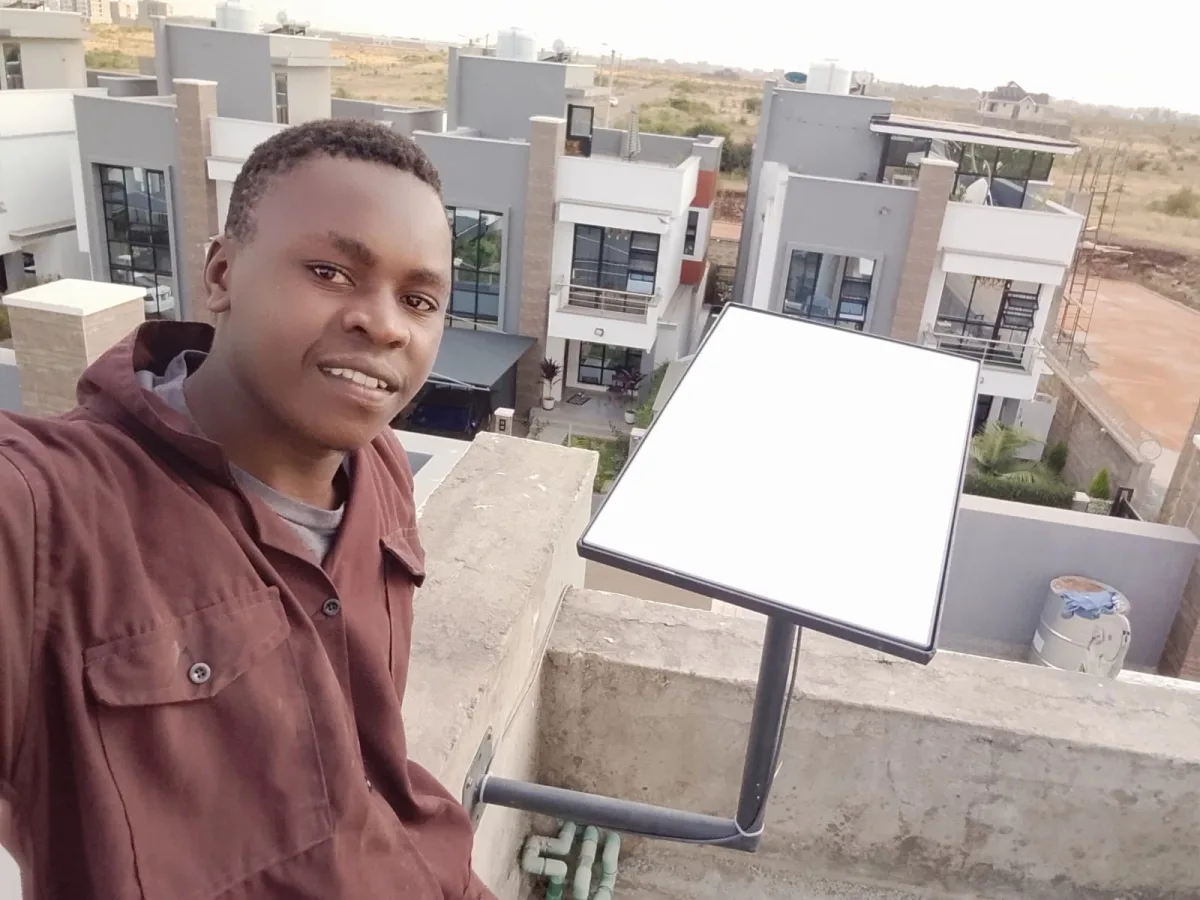
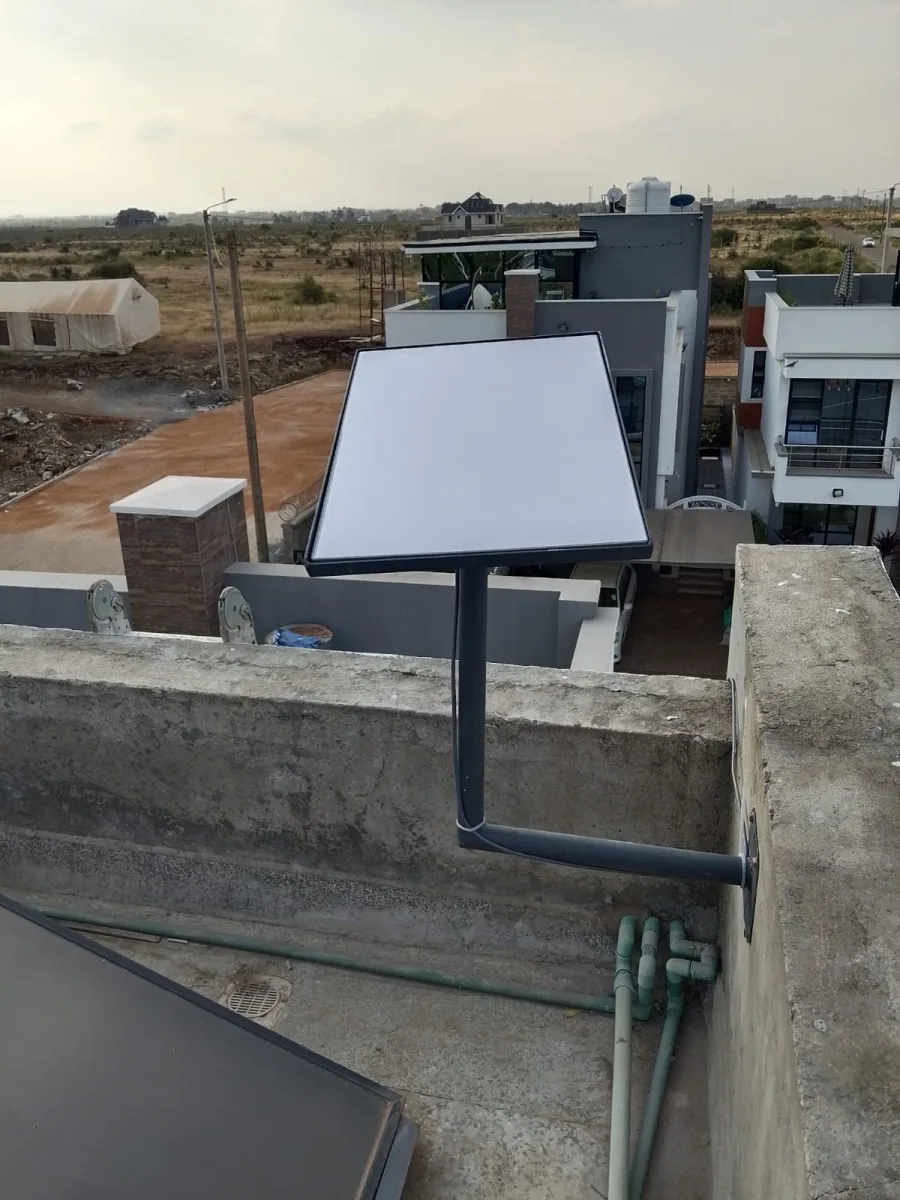
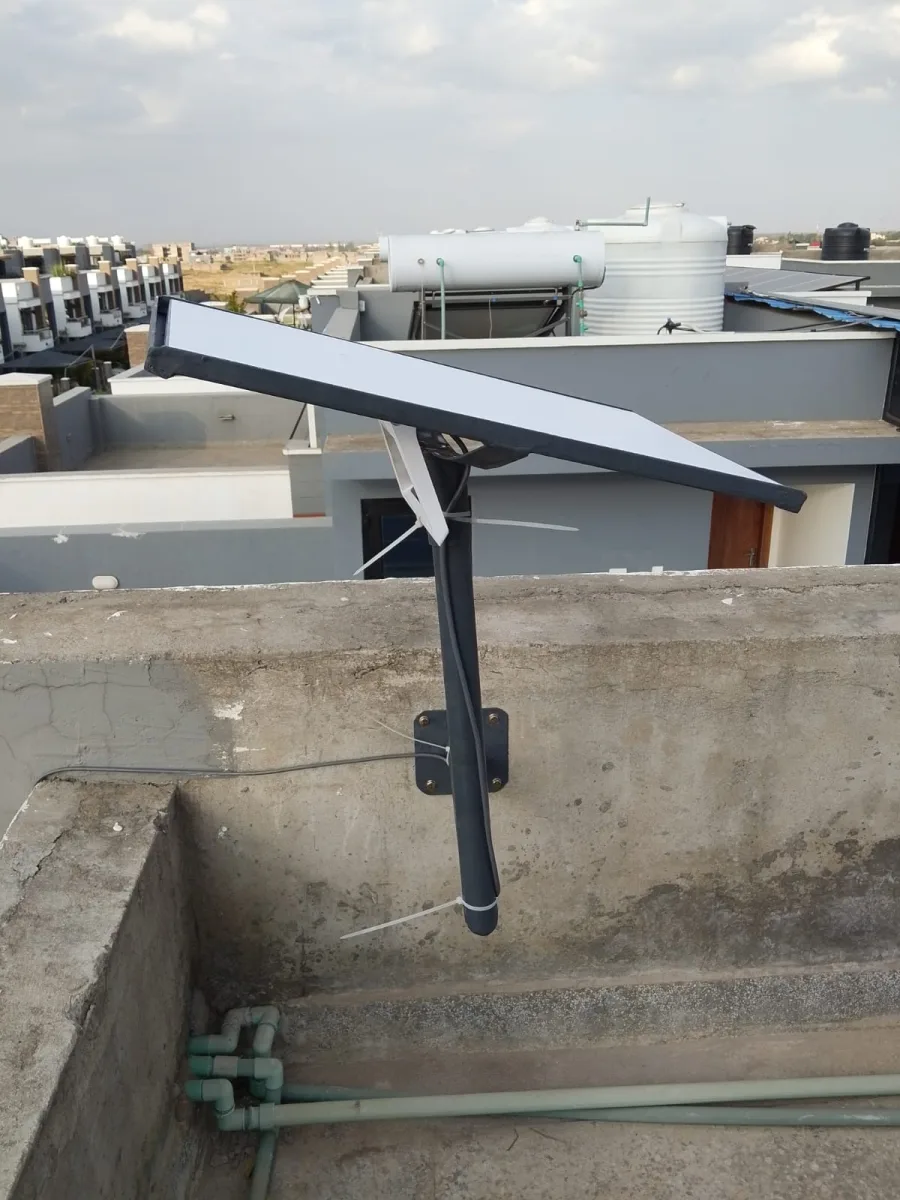
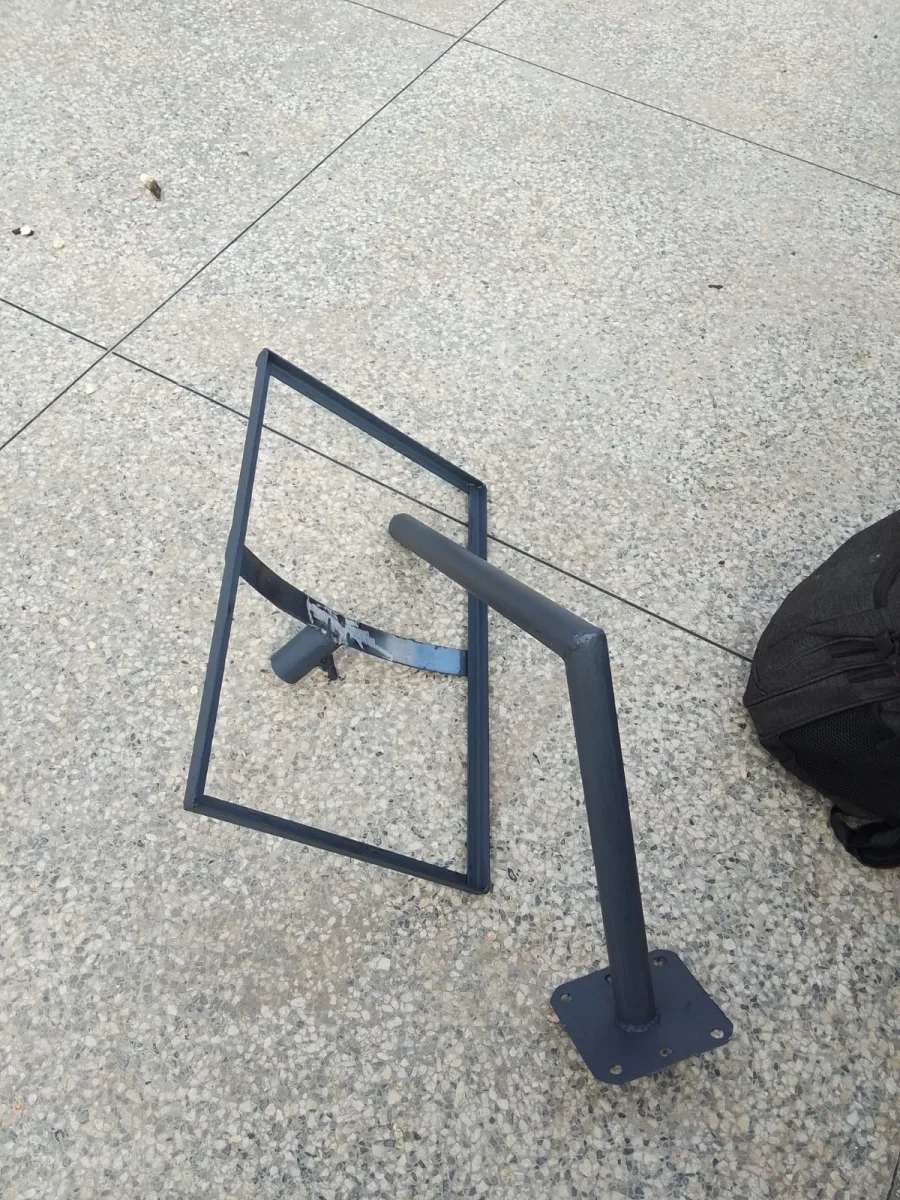
Need Starlink Installation or Network Optimization?
We help homes, offices, apartments, and businesses with Starlink installation, WiFi coverage improvement, and professional setup in Kenya.
Request Installation Chat on WhatsAppA transparent way to budget for equipment, labour, mounting and network work
Talk to Spacekits
Need Starlink help for your home or business?
Talk to Spacekits before you buy or book installation. We help with kit supply, mounting, activation, router placement, WiFi coverage, and written quotes.
Starlink Installation Cost in Kenya
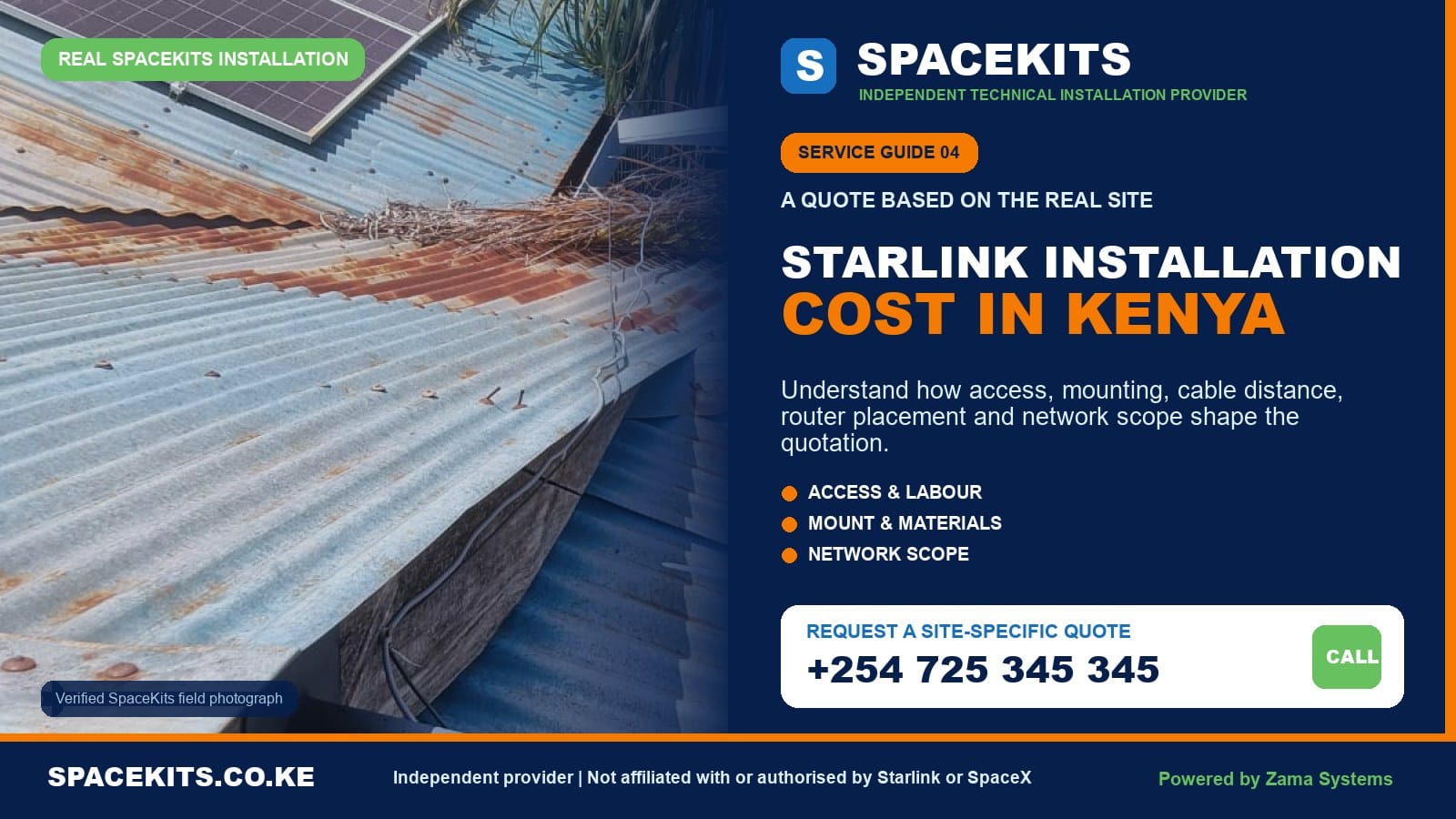
Starlink Installation Cost in Kenya searches often lead to one unexplained number. That number can be misleading because customers are usually comparing different things: equipment purchase, official subscription charges, professional labour, mounting hardware, cable protection, travel, Wi-Fi extension or repair of an existing installation. SpaceKits uses a site- and scope-based quotation so you can see what you are paying for and what remains outside the project.
A safely accessible bungalow with a complete kit and compatible mount is not the same job as a high apartment rooftop, steep tiled roof, lodge, warehouse, school campus or remote farm. Even two similar houses can need different work because one has a clear sky view and a short cable route while the other needs a pole, concealed containment and mesh coverage. A useful quotation describes those differences instead of pretending one price applies everywhere in Kenya.
Ask for an installation quote: send your exact pin, county or town, property type, kit model, photos of all equipment, roof or mounting area, proposed cable route and rooms or buildings requiring Wi-Fi. Request a location-aware quotation on WhatsApp or call +254 725 345 345.
Independent-provider notice: SpaceKits is an independent Kenyan installation provider. We are not Starlink or SpaceX. Official hardware prices, subscriptions, plan availability, account decisions, billing, warranties and support policies are controlled by the relevant official provider or seller and may change independently of our installation service.
Separate the six cost categories before comparing prices
The phrase “Starlink installation cost” is used for several different purchases. A customer can think an installer is expensive because they are comparing a labour-only figure with a quote that includes a bracket, pole, cable containment and mesh Wi-Fi. Another customer can believe a cheap package includes the Starlink kit or monthly plan when it covers only mounting. Ask every provider to separate the categories.
1. Starlink equipment
The terminal, router or integrated unit, power equipment and supplied cable are the principal hardware. Their price depends on the exact kit, sales channel, promotion and date. SpaceKits will not invent or freeze an official retail price inside a long-lived service article. Confirm the current amount, contents, warranty and seller status before purchase. A lower hardware price is not useful if the kit is incomplete, incompatible, account-locked or intended for another market.
2. Official service plan and account charges
The recurring plan is different from physical installation. Activation timing, subscription amount, plan name, priority, mobility permissions and capacity are controlled through the official service. Installation labour does not include recurring data unless a written agreement explicitly says otherwise. Customers should retain their own login, email, payment method and recovery access.
3. Professional installation labour
Labour can include remote assessment, travel, site inspection, safe access, obstruction checks, mount fitting, terminal placement, cable routing, entry finishing, indoor equipment positioning, setup assistance, testing and handover. The time and crew vary. A simple accessible wall mount is not the same as a commercial roof requiring permits and coordinated access.
4. Mounting and installation materials
The kit may not include the permanent support suitable for the property. A compatible wall bracket, pole, roof mount, adapter, fasteners, braces, conduit, trunking, clips and sealing materials are physical items. They should appear as separate lines or a clearly described materials package. Mounts can be specific to hardware generations, so buying the cheapest generic bracket before identifying the kit can waste money.
5. Internal Wi-Fi and network work
Getting the terminal online and covering a large building are different tasks. Mesh units, access points, Ethernet adapters, switches, firewall integration, point-to-point links and structured cabling add equipment and labour. A quote for a school, hotel or office should describe the coverage zones and devices instead of promising whole-property Wi-Fi from one router.
6. Special access, travel and remedial work
Remote travel, paid parking, restricted working hours, an extra technician, high-access equipment, trenching, fabrication, removal of an old system or correction of an unsafe previous installation can add cost. These are not tricks when they are disclosed before work. They become a problem when a provider advertises a low figure and reveals them only after arriving.
The most useful customer question is therefore: “What exactly is included for my site?” Ask for a written scope that identifies assumptions. If roof access, mount compatibility or cable distance is unknown, expect the quote to be conditional until those details are confirmed.
What affects professional Starlink installation labour?
Remote screening versus a physical survey
Clear photographs, a map pin and kit details can allow SpaceKits to screen a straightforward property remotely. A tall building, hidden roof, warehouse, lodge, campus or uncertain cable route may need an on-site survey. Survey time can be part of the project or separately priced. Paying for a complex-site survey can prevent a much larger mistake, such as buying the wrong mount or discovering that the intended route is impossible on installation day.
Number of technicians
Some safe accessible work can be completed by one technician, while roof access, long poles, cable pulling, commercial procedures or equipment handling may require more people. A quotation should reflect safe staffing. Choosing one person solely to reduce labour can create avoidable risk and poor workmanship.
Time on site
Time is influenced by access delays, mount assembly, drilling, route complexity, containment, account readiness and testing. If a caretaker cannot open the roof or the customer has not obtained landlord approval, the crew may be unable to work. A return visit has a real transport and scheduling cost. Preparing access before the appointment protects the customer’s budget.
Work permits and operating hours
Offices, malls, hospitals, factories and managed apartment buildings may require induction, work permits, security escort, insurance documents or after-hours work. State those requirements when requesting the quote. A quiet home appointment and a controlled commercial site cannot be scheduled as if they are identical.
Testing and handover
A complete service should include more than physically tightening a bracket. The installer reviews status through the customer’s official application, checks the cable and power arrangement, tests basic connectivity and explains limitations. Where wider Wi-Fi is included, agreed points should be tested. The customer should know whom to contact for installation workmanship and when an issue belongs to the official account or hardware support route.
How mounting method changes the installation cost
A permanent mount is selected for the exact terminal and building. Current official guidance distinguishes mount families across Starlink hardware. A Standard accessory, Mini adapter and Performance mount should not be treated as interchangeable. Compatibility, support strength, orientation and cable clearance matter as much as the price of metal.
Wall bracket
A wall bracket can be economical where sound masonry near the roofline has a clear sky view and offers a short route. Cost increases when the wall is high, access is difficult, an extended stand-off is needed or the substrate requires a different method. Weak blockwork, decorative cladding or a cracked wall can make a simple bracket unsuitable.
Short building-attached pole
A short compatible pole can raise the terminal above an eave or parapet. The pole diameter, adapter, brackets, spacing, fasteners and exposed height define the system. A customer-supplied pipe can reduce material cost only if it is suitable. Thin, corroded or excessively tall pipe should not be installed merely because it is already available.
Ground pole or fabricated support
A detached pole may avoid a fragile roof and provide a clear view. It can require a foundation, fabrication, corrosion protection and a protected route to the building. Long underground containment or a path across a driveway adds work. Significant civil or structural work is quoted separately.
Roof mount
Roof material and access drive the scope. Flat concrete, mabati, tiles and long-span commercial roofs need different planning. Waterproofing, drainage, underlying structure and future maintenance should be considered. Review the detailed Starlink roof installation guide before comparing a roof quote with a low ground-level figure.
Existing mount reuse
Reusing a compatible sound mount can save materials, but it should be inspected. Corrosion, loose fixings, wrong diameter, poor location or damage may make reuse false economy. Remedial work can be quoted after the existing support is assessed. Removing abandoned equipment may be a separate task.
Wind and environmental exposure
Coastal salt, open plains, high ridges and tall buildings may justify different materials or support. Stronger design can cost more initially but reduce movement and repeat visits. No installer can guarantee survival in every extreme event, yet selecting a mount only by lowest price ignores the environment in which it must operate.
Cable routing and finish: the cost customers often overlook
The supplied cable should be treated as system equipment. Official troubleshooting guidance recommends inspecting for kinks, damage and weather exposure and generally using official compatible cables. A route should be measured before the terminal is fixed. If it is too long, the solution must match the exact hardware rather than using an improvised join.
Simple external route
A short route along an accessible wall with appropriate support requires less labour and material. Even this route needs protection at sharp edges, a weather-aware building entry and no tension at connectors. “Simple” should not mean a loose cable through a window.
Conduit and trunking
Customers may prefer containment for appearance and protection. The dimensions and bends must allow the actual connector to pass without damage. External conduit, indoor trunking and transitions add materials and fitting time. Decorative finishing or repainting may be outside the installation unless agreed.
Concealed ceiling route
Routing through a ceiling can create a clean result, but access panels, insulation, existing services and the ability to pull the connector affect the work. Fragile ceilings and unknown electrical routes require care. Ceiling repair is not assumed. Share building information before the quote.
Several floors or long commercial paths
A path from a rooftop to a ground-floor network room may involve risers, ducts, fire-stopping rules and facilities approval. It is not comparable to a bungalow. At some distance, placing the Starlink equipment nearer the entry and distributing the network by another medium may be better. That becomes a business-network design, not just a long cable.
Between buildings or underground
A connection from a pole or one building to another may need protected underground cable, fibre, Ethernet within applicable limits or a wireless point-to-point link. Trenching should consider drainage, vehicle loads and known services. SpaceKits separates that scope from the terminal installation so customers can budget in phases.
When mesh Wi-Fi and network work add to the budget
The Starlink router or integrated Wi-Fi source has a finite coverage area shaped by walls, slabs, metal and interference. A large property may have an excellent satellite link but weak Wi-Fi in distant rooms. Installation quotations should identify whether they cover only the Starlink system, a basic router setup or a measured wider network.
Mesh Wi-Fi
Mesh can help homes and smaller multi-room properties, but node count and placement matter. A node placed where it already receives a poor signal cannot create a strong upstream link. Wired backhaul may improve some buildings. Equipment, configuration and testing are additional lines rather than invisible parts of roof labour.
Wired access points
Offices, schools, lodges and large homes often benefit from planned access points connected by cable. This can provide more predictable coverage and user capacity. The quote may include cable, containment, switch ports, access-point hardware, configuration and labelling. Network security and ongoing management can be separate services.
Business failover
A business can use Starlink as primary or backup connectivity. Automatic failover usually requires a compatible router or firewall, authorised configuration and testing of real applications. The cost depends on existing equipment and IT policy. Simply connecting both providers to an unmanaged switch does not create a proper failover design.
CCTV, point of sale and remote systems
Customers may want cameras, payment devices or cloud applications to use the connection. Their requirements, addressing, vendor accounts and security settings are separate from Starlink mounting. SpaceKits can quote an integration assessment, but should not promise that every legacy system will work without inspection.
For customers focusing on coverage, the dedicated Starlink Wi-Fi extension and mesh setup service guide explains how to prepare a floor plan and device list.
Why different Kenyan properties receive different installation quotes
Accessible bungalow
A single-storey house with open sky, sound wall or roof access, a complete kit, suitable supplied mount and short route is the baseline many advertised prices assume. Confirm whether the price includes the permanent mount, transport, entry finishing and testing. If it excludes all four, it is not a complete comparison.
Maisonette or multi-storey home
Height, roof pitch and safe ladder position can require additional crew or equipment. Router placement on one floor may not serve another, increasing the network scope. A customer can control cost by sending clear photos and deciding which rooms need coverage rather than demanding an undefined “whole house” result.
Apartment
A tenant may need rooftop approval, common-area routing, caretaker access and a long drop to the unit. Balconies can be obstructed. Management delays and return visits add real cost. The customer should secure permissions and route approval before booking.
Office or shop
The terminal installation may be straightforward, while network integration is the larger task. Security, work hours, ceiling access, rack location, Ethernet and failover affect the quote. An authorised IT contact should explain existing equipment before changes are made.
School, clinic or hospitality property
These sites usually have several user zones and operational risks. Roof work may require approval, while Wi-Fi may need separate access points, guest controls and backup power. A phased proposal can start with the internet link and add network coverage after measurement.
Farm or remote compound
Travel, tree obstructions, power quality, long distances and several buildings can change the design. A wall or pole at the main house may be easy, but extending service to a gatehouse or field office adds network work. Send an annotated compound sketch to reduce survey uncertainty.
Warehouse or industrial site
High metal roofs, restricted access and large internal spaces can require specialist planning. Metal can limit Wi-Fi, so indoor access points may be needed. Site induction, permits and safe work windows belong in the quote.
How to compare Starlink installation quotations fairly
Do not compare only the final total. Create a checklist and ask each provider to answer the same questions. A higher quote may include a compatible mount, two technicians, cable containment and testing, while a lower one covers only travel and temporary placement. The written scope reveals the difference.
- Is the exact kit model identified? Generic wording can hide an incompatible mount assumption.
- Is the installation position described? “Roof” is not enough; ask for the proposed mounting type and access assumption.
- Are the mount and materials included? Ask for model, basic description or allowance and whether fabrication is separate.
- What cable finish is included? Clips, conduit, trunking, drilling and sealing should not be left vague.
- How many technicians and what access? Confirm whether a ladder, lift or specialist work is assumed.
- What testing is included? Basic online status and a nearby speed test differ from multi-room coverage testing.
- Is Wi-Fi extension included? Identify equipment, number of points and configuration.
- Are transport and taxes stated? Avoid discovering travel charges after the team departs.
- What can change the price? A conditional quote should list the conditions.
- Who supports what? The installer handles workmanship; account, billing and official hardware decisions may belong elsewhere.
Ask for photographs of relevant prior work, but remember that another customer’s roof does not prove suitability for yours. Avoid claims of guaranteed speed, guaranteed activation or official affiliation that cannot be supported. A serious provider explains limitations before taking payment.
How to reduce installation cost without sacrificing safety
Send complete information once
A location pin, kit photo, property photos, floor count and coverage requirement reduce unnecessary travel. Lay all accessories out clearly. State whether a mount was purchased and provide its model. Do not say “everything is complete” when the box has not been checked.
Confirm access and permission
Arrange the caretaker, roof key, landlord consent, parking and work window before the appointment. Avoid paying for a failed visit because no authorised person can approve drilling. Commercial sites should share induction requirements in advance.
Choose the simplest suitable route
A neat visible route in well-chosen containment can cost less than concealed work through several ceilings while remaining professional. Decide where appearance matters most. Do not insist on the shortest cable if it creates a poor router location, and do not insist on total concealment without accepting the extra access work.
Buy accessories after compatibility is confirmed
The cheapest wrong bracket costs more after replacement. Let the exact kit and site determine the mount. If supplying your own materials, agree the specification before purchase and understand that SpaceKits can decline unsafe items.
Phase the network
A business or lodge can install and test the Starlink link, then add access points based on measured gaps. A home can begin with sensible router placement and add mesh only where necessary. Phasing should not mean leaving unsafe cable or temporary mounting indefinitely.
Protect the installation
Periodic visual checks, safe power, cable protection and prompt repair of looseness can prevent larger costs. Do not move the terminal casually after an obstruction assessment. Keep a record of the route before renovations and tell contractors where cables run.
A quote-request template that produces a more accurate answer
Customers often begin with, “How much is installation?” The installer then has too little information and either guesses or sends a long list of questions. A structured first message saves time. State: “My location is [pin, estate or town]. The property is a [bungalow, maisonette, apartment, office, school, lodge or farm]. It has [number] floors and a [roof material] roof. I own [exact kit model], and the box contains [components]. I already have [mount or no mount].”
Continue with the intended result: “The connection should serve [rooms, users or buildings]. The proposed terminal area is shown in the attached wide photographs. The indoor equipment could be placed in [room]. Roof or wall access is [available, restricted or unknown]. The landlord or facility approval is [confirmed or pending].” Add scheduling or security requirements and ask the provider to separate labour, mounting materials, cable finish, travel and optional Wi-Fi work.
This template does not replace a survey where the structure or route is uncertain. It does allow the installer to identify obvious gaps before travelling. Photographs should be taken from safe positions; do not climb onto a roof for a quote. Do not send account passwords, payment details or recovery codes.
Warning signs in a quotation
Be cautious when the exact kit is never requested, the mount is described only as “free,” roof access is assumed without photographs, or whole-building Wi-Fi is promised without a floor plan. Other warning signs include guaranteed speed, guaranteed activation, claims that every cable can be joined, pressure to share account credentials and refusal to provide inclusions in writing.
A very low total is not automatically dishonest, and a high total is not automatically professional. Evidence is the difference. Ask what support is used, what route is included, what happens if the first position is obstructed and whether a return visit is charged. A good quotation makes the decision easier even if the customer chooses another provider.
Save the final quotation and completed-work photographs for maintenance, relocation, warranty discussions and future changes to the property.
What SpaceKits can quote and what remains outside our control
Depending on the site, a SpaceKits quotation can cover assessment, installation labour, mount or adapter supply, cable protection, basic setup, testing, mesh Wi-Fi, access points, Ethernet work, relocation or remedial service. Every item must be written into the quote. We do not imply that a low headline amount includes equipment, subscription and unlimited networking.
We cannot set or guarantee official kit prices, subscription rates, promotions, capacity, account activation, ownership transfers, billing outcomes or hardware warranty decisions. We cannot promise a fixed internet speed because performance depends on the service, environment, obstructions, plan, network demand, devices and local Wi-Fi.
Structural engineering, asbestos work, major roof repair, tree removal, high-voltage electrical work and extensive civil works are outside a routine installation unless provided by appropriately qualified parties in a separate agreement. Unsafe access may be declined. Used or damaged kits can require official support or seller resolution before installation proceeds.
For physical faults after installation, review the Starlink repair Kenya guide. For customer-owned equipment in Nairobi, the installation-only Nairobi page explains what details speed up the quote.
Get a transparent Starlink installation quotation
Use a single message with the county, nearest town or estate, exact pin, property type, number of floors, roof material, kit model, supplied components, mount details, candidate installation photos, router location and required coverage. Mention access restrictions and preferred timing. Do not send account passwords or card details.
SpaceKits will tell you whether remote evidence is enough for a conditional quote or whether a survey is needed. The written response can separate labour, materials, travel and optional network services so you can make a real comparison.
Frequently asked questions about Starlink installation cost in Kenya
1. What is the fixed price for Starlink installation in Kenya?
There is no honest universal figure for every property. Location, safe access, mount, cable route, building height, materials and network work differ. SpaceKits quotes the actual site and separates inclusions.
2. Does the installation price include the Starlink kit?
Not unless the written quotation explicitly lists the kit. Equipment purchase, official subscription and independent installation labour are separate categories.
3. Does installation include the monthly subscription?
No, unless explicitly arranged through the appropriate official channel. The customer controls the official account and recurring charges. SpaceKits does not set plan prices.
4. Why does roof height affect labour cost?
Height can require additional crew, access equipment, safety planning and more time. A high or steep roof is not equivalent to an accessible bungalow wall.
5. Is a mounting bracket included?
Only if listed. The mount must fit the exact hardware and building. Ask whether the quote covers the bracket, adapter, pole, fasteners and fitting.
6. Will cable trunking cost extra?
It may be a separate materials and labour line, especially for concealed, multi-floor or long routes. The quote should state the included finish.
7. Is mesh Wi-Fi part of installation?
Only when specified. Basic terminal setup and whole-property Wi-Fi are different scopes. Mesh units, access points, cabling and configuration are quoted from actual coverage needs.
8. Can photos provide an accurate quote?
Clear photos and a pin can support a conditional quote for straightforward sites. High, restricted, commercial or uncertain properties may require an on-site survey before a final amount.
9. Does SpaceKits charge for travel outside Nairobi?
Travel depends on the location, route and project. Any travel amount or assumption should be disclosed in the quotation rather than hidden after booking.
10. Can I supply my own mount to reduce cost?
Yes if it is complete, compatible and suitable for the structure and exposure. SpaceKits may decline unsafe, damaged or mismatched hardware.
11. Does professional installation guarantee a specific speed?
No. Good installation reduces avoidable physical and Wi-Fi problems, but service performance varies. A fixed speed cannot be honestly guaranteed at every time and location.
12. What should I send for the most useful quote?
Send the exact pin, property and roof type, floor count, kit photos, mount details, cable destination, access restrictions and rooms or buildings needing Wi-Fi. Do not send passwords or payment information.
Need Starlink Installation or Network Optimization?
We help homes, offices, apartments, and businesses with Starlink installation, WiFi coverage improvement, and professional setup in Kenya.
Request Installation Chat on WhatsApp