
Need Starlink Installation or Network Optimization?
We help homes, offices, apartments, and businesses with Starlink installation, WiFi coverage improvement, and professional setup in Kenya.
Request Installation Chat on WhatsAppStarlink for dairy collection centres should be planned around the receiving shift, not around an impressive speed-test screenshot. A collection centre may need to register deliveries, communicate with transport teams, synchronise records and prepare reports during a short, busy period. When the connection becomes unreliable, the immediate problem is often a queue of people waiting for a task that should take seconds. A useful network design begins by understanding that workflow.
Talk to Spacekits
Need Starlink help for your home or business?
Talk to Spacekits before you buy or book installation. We help with kit supply, mounting, activation, router placement, WiFi coverage, and written quotes.
This guide to Starlink for dairy collection centres helps Kenyan committees and managers prepare a practical connectivity brief. It is especially relevant where dependable fixed broadband is unavailable or where an existing connection needs a separately assessed backup. The focus is on ordinary communications and business records. Internet connectivity does not validate milk quality, replace operational controls or guarantee the reliability of processing equipment.
A workable design for Starlink for dairy collection centres combines internal networking, account ownership, backup power and an offline procedure. Those components should be priced and tested together. Before buying, compare the local options that can actually serve the premises and confirm current Starlink availability for the address. For installation support, use the SpaceKits installation service page and explain the centre’s operating hours, layout and essential online tasks.
Starlink for dairy collection centres: Start with the journey of one delivery record
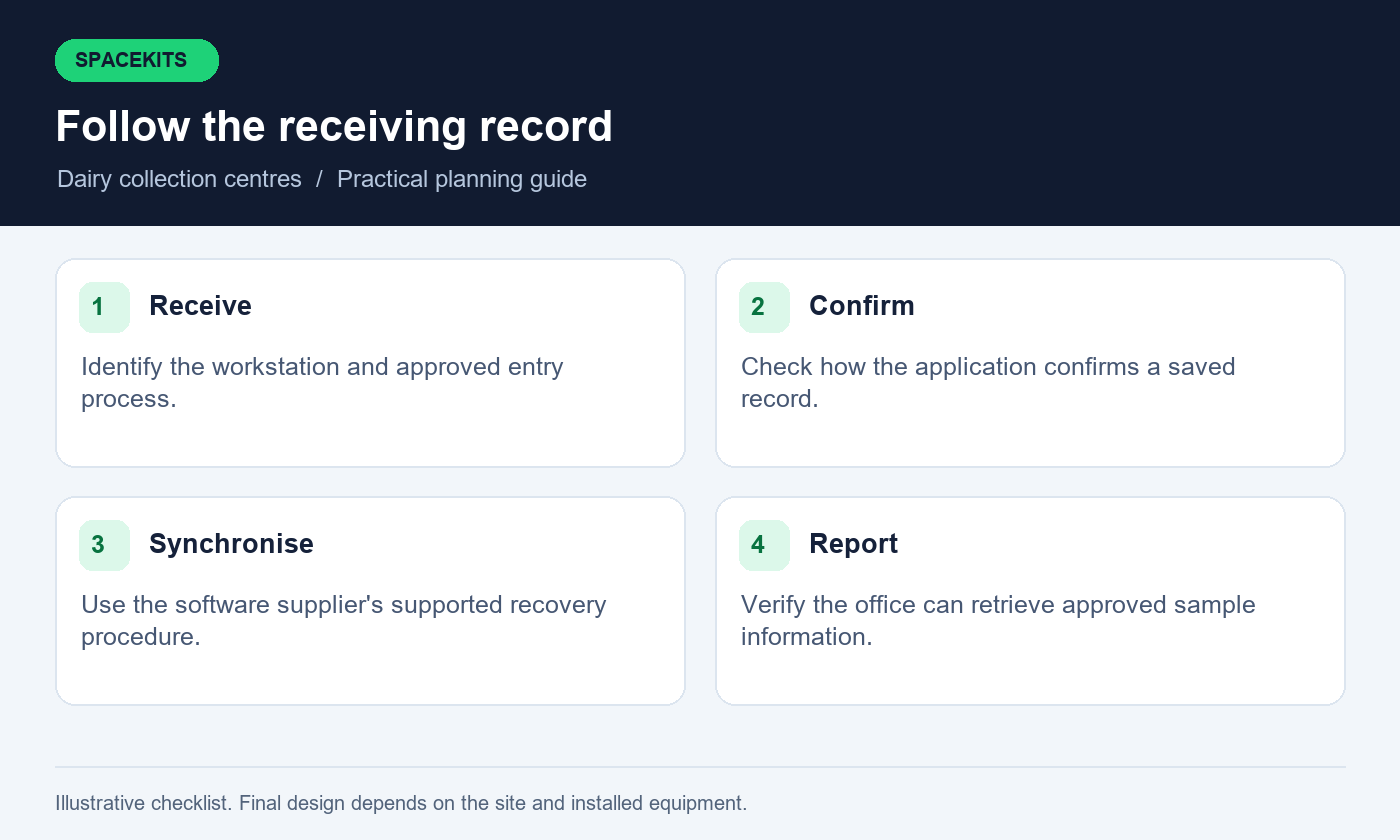
Plan Starlink for dairy collection centres by following one delivery from arrival to the authorised office record. Which person enters the information? Which device is used? Does the application save locally, immediately send data to a remote system, or wait for a later synchronisation? These questions reveal where connectivity is genuinely required. Do not assume that all digital equipment needs continuous internet simply because it has a screen.
Before deploying Starlink for dairy collection centres, ask the software supplier to explain failure behaviour. A spinning indicator might mean an entry is queued, rejected or still awaiting confirmation. Staff need to distinguish those states before they repeat an action. The network installer cannot safely guess how the dairy software handles interrupted submissions. Record the supplier’s instructions in the operating procedure and test them with sample records that contain no real member information.
Document the workflow that Starlink for dairy collection centres needs to support on one page. Show the receiving desk, supervisor, office and any remote reporting destination. Mark where a delay stops the next activity and where work can continue offline. This prevents the project from becoming a general WiFi purchase without a defined business outcome. It also helps the committee understand why a stable desk connection may matter more than coverage throughout every outdoor space.
Describe the busiest operating window
Assess Starlink for dairy collection centres during a normal busy shift before choosing equipment. Count the devices used together and note their tasks. Receiving tablets, an office computer, staff phones and a network printer may create very different demands. A background cloud backup or large software update can compete with small but urgent record submissions. The purpose of the observation is to identify concurrency and priority, not to collect private details about members.
Demand planning for Starlink for dairy collection centres includes activities immediately before and after receiving. Staff may download lists before opening, send summaries when the shift closes or coordinate a vehicle while the office prepares reports. A system tested only at midday could miss the centre’s actual problem period. Where several collection points report to one office, document whether their peak periods overlap and how that affects the central application’s workload.
Write the demand statement for Starlink for dairy collection centres: workstations, essential activities and overlapping tasks. Treat these as design inputs rather than guaranteed bandwidth calculations. Application behaviour, connection conditions and internal network quality all matter. Ask the installer to propose acceptance tests that resemble the observed shift, and ask the software provider to confirm that the planned test is meaningful.
Compare available connections at the actual premises
Compare Starlink for dairy collection centres with local fibre, fixed wireless and mobile broadband at the actual site. A coverage claim for a nearby town does not establish service at the collection building. Obtain a location-specific response, installation requirements and the current terms. Where a provider offers a demonstration or trial under clear conditions, use it to test the centre’s ordinary tasks rather than relying only on headline advertising.
Evaluate Starlink for dairy collection centres through its complete operating arrangement, including power, support and ongoing charges. A cheaper connection that cannot be supported during receiving hours may impose a practical cost that the quotation hides. Conversely, a more expensive option is not automatically necessary for a few lightweight transactions. The committee should understand the problem being solved before approving a package or a second connection.
For Starlink for dairy collection centres, verify equipment, address and suitable service through the current official process. Avoid assumptions based on another farm’s bill or a promotion seen months earlier. SpaceKits can quote local equipment and installation work, while service eligibility and provider terms must be verified with Starlink. Keep the two responsibilities clear in the procurement record so later support requests reach the right party.
Choose a dish position that fits the working site
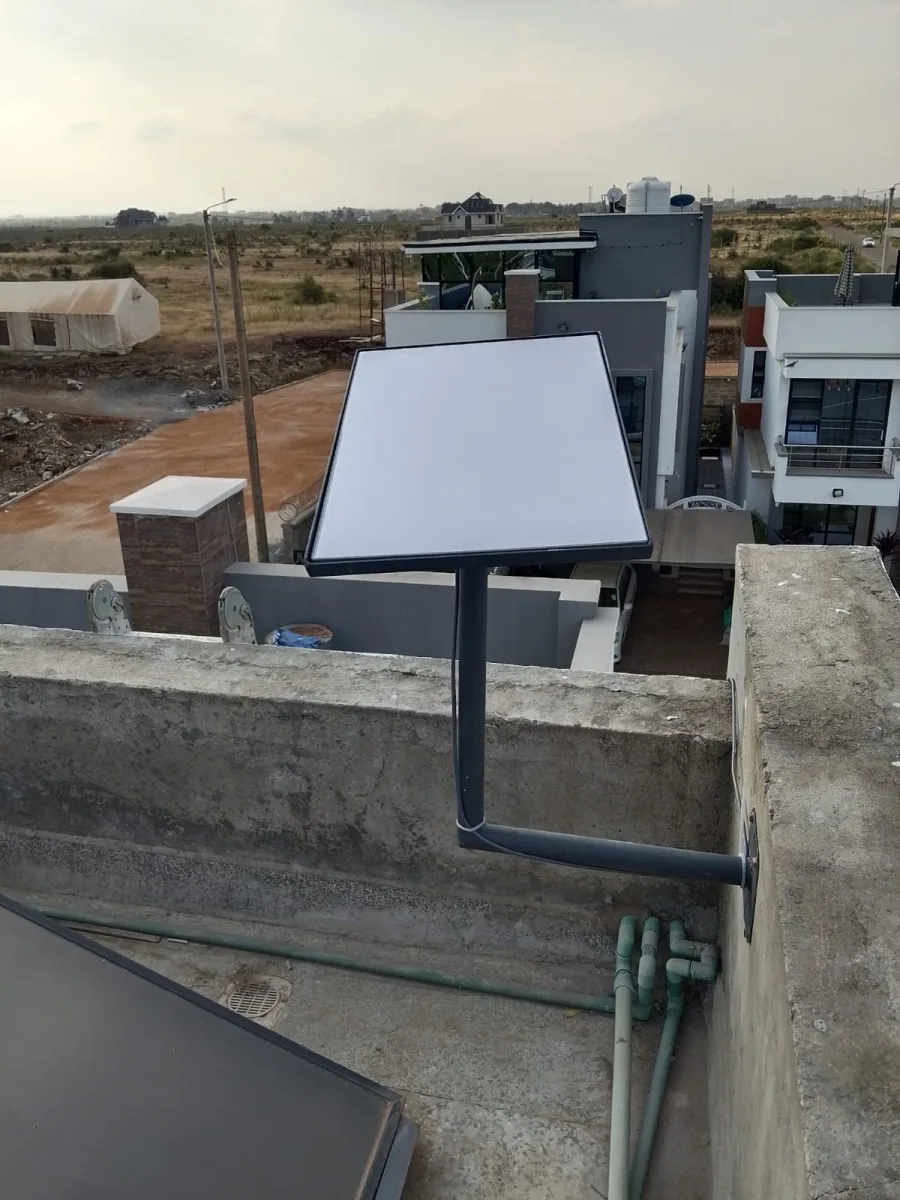
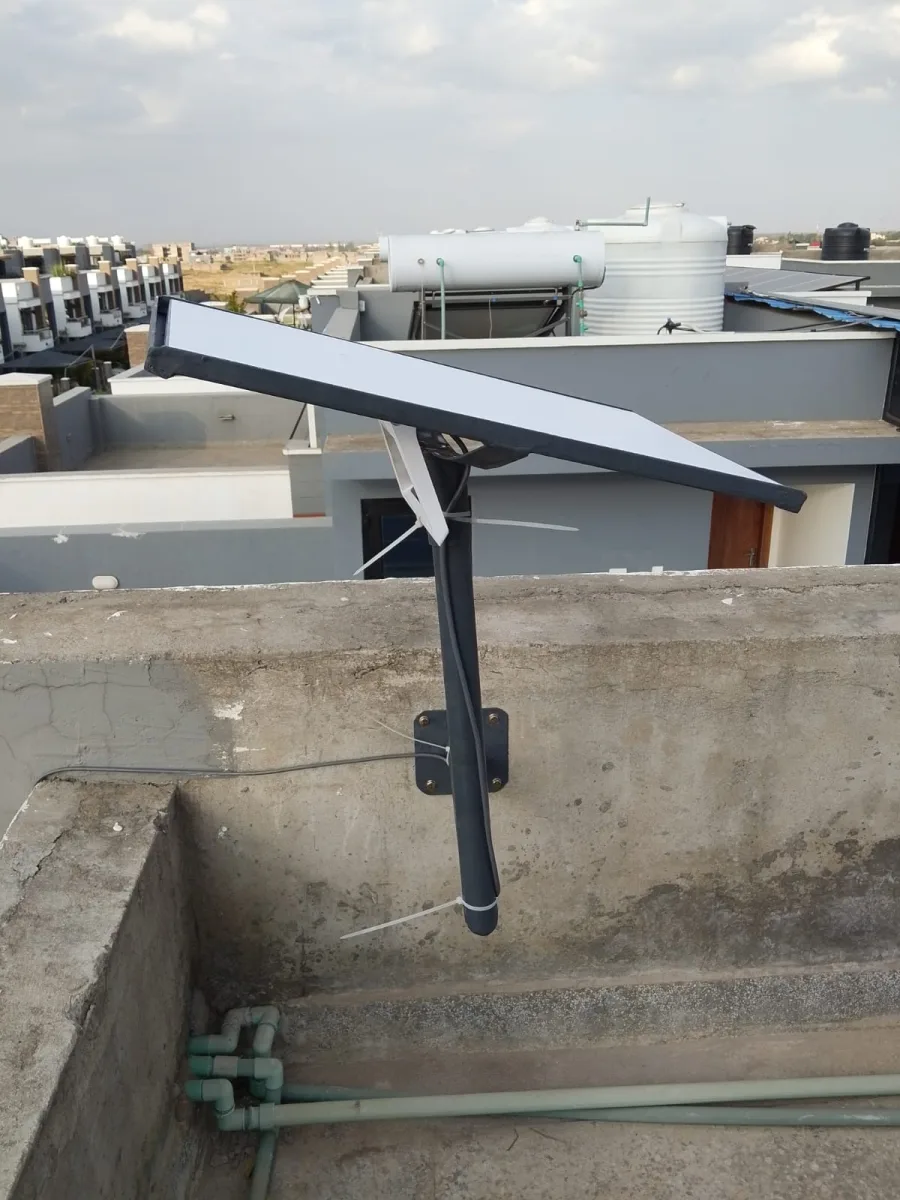
Siting Starlink for dairy collection centres requires checking roofs, surrounding trees, tanks and loading structures. The proposed dish position needs an appropriate sky view and a secure mounting arrangement assessed for the site. Use the Starlink app’s obstruction tools and the applicable installation instructions. Do not select a location solely because the power socket below it is convenient or because the dish is less visible there.
When surveying Starlink for dairy collection centres, explain vehicle and pedestrian movements to the installer. A cable route should not interfere with loading, cleaning, door operation or regular maintenance. Equipment must not be placed where it becomes an obstacle or is likely to be struck. Any work at height or changes to electrical infrastructure require suitably qualified people and the appropriate site arrangements. Receiving staff should not be expected to improvise such work.
Consider future alterations when planning Starlink for dairy collection centres. A planned canopy, new storage building or growing tree can affect an installation that works today. Mark the agreed position and cable path on the premises drawing. Obtain the owner’s permission before drilling or mounting on rented premises. The goal is an installation that can be maintained without repeatedly interrupting the centre or creating uncertainty about who may authorise a change.
Separate the receiving environment from equipment storage
Installing Starlink for dairy collection centres requires attention to moisture, cleaning and frequent movement around the working area. Identify a suitable location for routers, switches and power supplies according to their manufacturer requirements. Indoor equipment should not be treated as weatherproof simply because it sits under a roof. Ask the installer to explain environmental suitability and service access rather than hiding everything in the nearest available corner.
Keep equipment supporting Starlink for dairy collection centres outside spaces routinely washed or filled with supplies. The chosen arrangement should allow ventilation and straightforward inspection without opening protected electrical components. Cable entries and supports need an appropriate professional design. If a location creates concerns about hygiene or safe operations, the site’s responsible personnel should resolve those concerns before the networking work proceeds.
Label the equipment supporting Starlink for dairy collection centres and specify who may move it. Cleaning teams should know which surfaces and sockets are outside their ordinary handling instructions. This is a coordination issue, not a request to weaken the centre’s cleaning standards. A good design accommodates the real working environment instead of depending on every employee remembering to protect an unsuitable installation indefinitely.
Give fixed workstations a dependable local connection
When distributing Starlink for dairy collection centres, assess a properly installed wired connection for permanent receiving desks. A cable can remove some wireless uncertainty, but its route, length, protection and termination must suit the building. It should not trail across a walkway or be repeatedly unplugged to move equipment. Where a tablet needs mobility, test WiFi at its actual working positions with ordinary doors and equipment in place.
When diagnosing Starlink for dairy collection centres, distinguish the internet service from the local network. The dish provides an upstream service; the router, switch, cable and access point distribute it inside the premises. If the office works while one desk repeatedly fails, investigate that desk’s path before concluding that the satellite connection is at fault. A simple diagram helps staff and support providers ask the right questions quickly.
The interface for third-party networking depends on the Starlink kit. The official third-party router guidance notes compatibility limitations and model-specific requirements. Have the installer verify the exact hardware and configuration. Do not buy an adapter or mesh system from a generic recommendation without checking that it matches the equipment the centre owns.
Design staff and visitor access deliberately
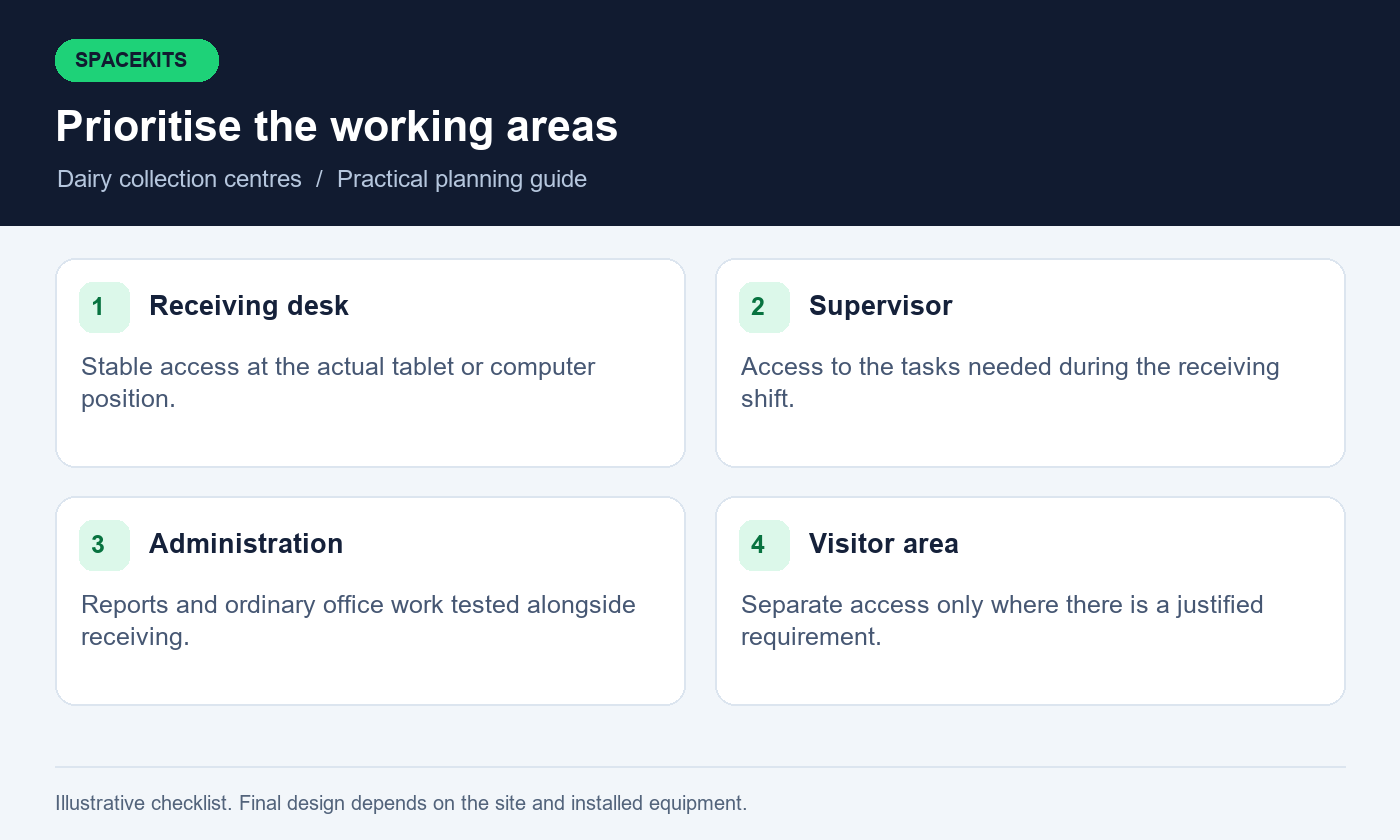
A design for Starlink for dairy collection centres should separate receiving and administration devices from unrestricted visitor access. Discuss a separate guest arrangement where visitor internet is genuinely needed. Ask the installer to demonstrate the intended isolation; different wireless names alone are not proof of separation. The required controls depend on the network equipment, so the written proposal should identify what will actually be configured and tested.
Decide whether visitor access belongs in the scope of Starlink for dairy collection centres during busy periods. Providing public access creates additional demand and support work. If it is offered, define its purpose, availability and limitations clearly. Do not promise unlimited service without confirming both technical capacity and the provider’s applicable terms. An operational network should not become an informal community hotspot simply because the password is widely circulated.
Give staff access that matches their role in the relevant business applications. A WiFi password is not an application permission system. Account management, record editing and reporting rights belong to the software’s own controls. When staff change, use the authorised process to update access while retaining business history. Keep that process separate from routine network troubleshooting so a connectivity issue does not trigger unnecessary account changes.
Prepare an offline receiving procedure with the software owner
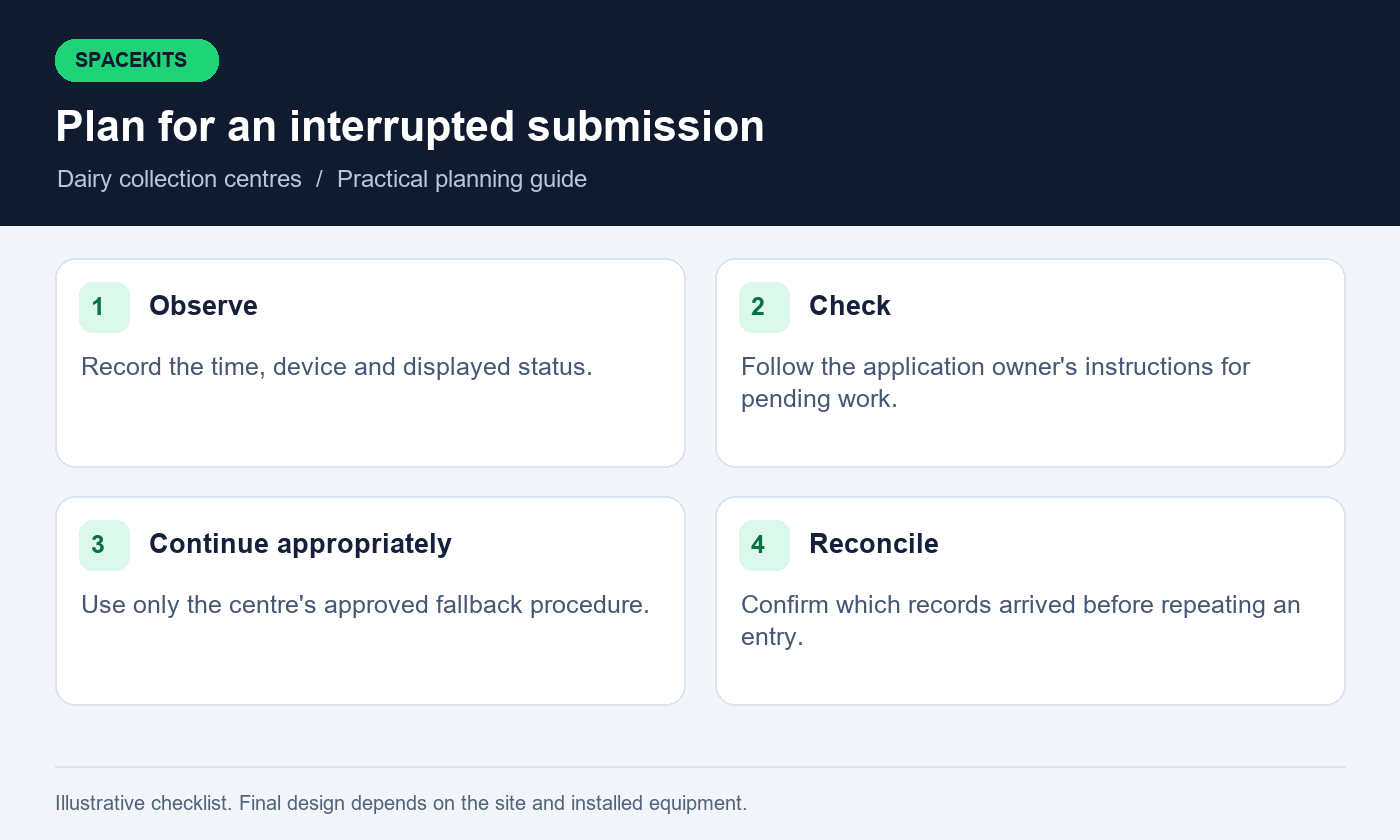
An outage procedure for Starlink for dairy collection centres must explain what happens when a submission cannot be confirmed. The answer must come from the centre’s approved operating process and the software supplier’s actual capabilities. Some systems support offline entry and later synchronisation; others do not. Do not assume that a browser left open will preserve unsent work. Test the agreed process before the first outage rather than discovering its limits during a queue.
If the centre uses a manual fallback, define how records are identified, protected and reconciled. Staff should know who authorises the fallback, where completed records are stored and how duplicate entry is prevented. This guide does not prescribe accounting or dairy compliance rules. The organisation’s responsible managers should approve the process and confirm that it meets their operational and recordkeeping obligations.
Include a recovery step in the operating procedure for Starlink for dairy collection centres. When the connection returns, someone must confirm which entries reached the system and which still need attention. Avoid asking every operator to resubmit everything simultaneously. A controlled reconciliation reduces confusion and provides a clear point of responsibility. Connectivity planning is successful when the team can continue appropriately and recover accurately, not merely when the router comes back online.
Size backup power around the complete network
Backup planning for Starlink for dairy collection centres must include every device needed for the receiving workflow. A powered dish is not enough if the tablet has an empty battery or a required switch has stopped. Give this list to the person designing backup power. Include the expected outage duration and the minimum activities the centre needs to sustain during that period.
Use measured loads and equipment specifications for the installed models. Do not borrow a power figure from a different Starlink kit and treat it as exact. Battery age, operating conditions and conversion losses affect runtime. A competent professional should assess the electrical arrangement and any integration with existing backup systems. Networking equipment must not be attached to processing equipment supplies through an improvised connection.
Commission Starlink for dairy collection centres with a supervised runtime test under representative workload. Record what remained operational and when the system reached its agreed stopping point. Decide how staff recognise low power and who may shut down equipment. Keep the procedure accessible offline. If the backup only supports essential records and communication, state that limitation clearly rather than suggesting that all centre operations are protected.
Assess a second internet connection as a separate project
Backup internet alongside Starlink for dairy collection centres needs its own evidence of usefulness during receiving. Test mobile or other backup service at the premises and during relevant hours. Confirm its power requirements and current subscription status. A spare router stored in a drawer without an active service arrangement is equipment inventory, not an operational backup.
For backup service alongside Starlink for dairy collection centres, choose between manual switching and a suitable router. Ask the installer to explain how the system detects a failure and what staff should expect during a change. Existing sessions may reconnect or fail, depending on the application. The software supplier should confirm how to handle incomplete submissions. A backup connection should be tested with the actual workflow before it is described as seamless.
Think about shared failure points. Two internet services still depend on electricity, the local network and functioning user devices. If both pass through one failed switch, neither reaches the receiving desk. The design should identify these dependencies and decide which are worth addressing. Spending on a second provider makes most sense when the team understands both the benefit and the interruptions it cannot prevent.
Write acceptance tests that a committee can understand
Acceptance tests for Starlink for dairy collection centres should replace vague promises with a short list of demonstrations. A sample receiving record should be submitted and confirmed. An authorised office device should retrieve the appropriate test information. A report should open while another workstation performs its normal task. Use test data approved by the software owner so no real member records or financial details are exposed during commissioning.
Include location and concurrent use in acceptance tests for Starlink for dairy collection centres. Test at the receiving counter, supervisor’s position and office, using the devices intended for those places. Run the agreed activities together for a representative period. Record failures as well as successes and repeat uncertain observations. A single demonstration on the installer’s laptop beside the router does not establish that the centre’s own devices work in their normal positions.
Document exclusions before signing off Starlink for dairy collection centres. If a remote store, outdoor queue area or future office is not included, say so explicitly. Record the date, participants, equipment and outstanding actions. The committee does not need pages of unexplained technical figures; it needs evidence that the promised operational tasks were demonstrated and a clear account of anything that remains unfinished.
Use a procurement brief that separates responsibilities
A procurement brief for Starlink for dairy collection centres should give suppliers the location, layout, equipment, workstations, hours and essential tasks. Include photographs of relevant spaces without member information or credentials. Ask for a site visit where remote assumptions could materially affect the quote. A detailed brief makes quotations more comparable and reduces the chance of discovering major exclusions after equipment arrives.
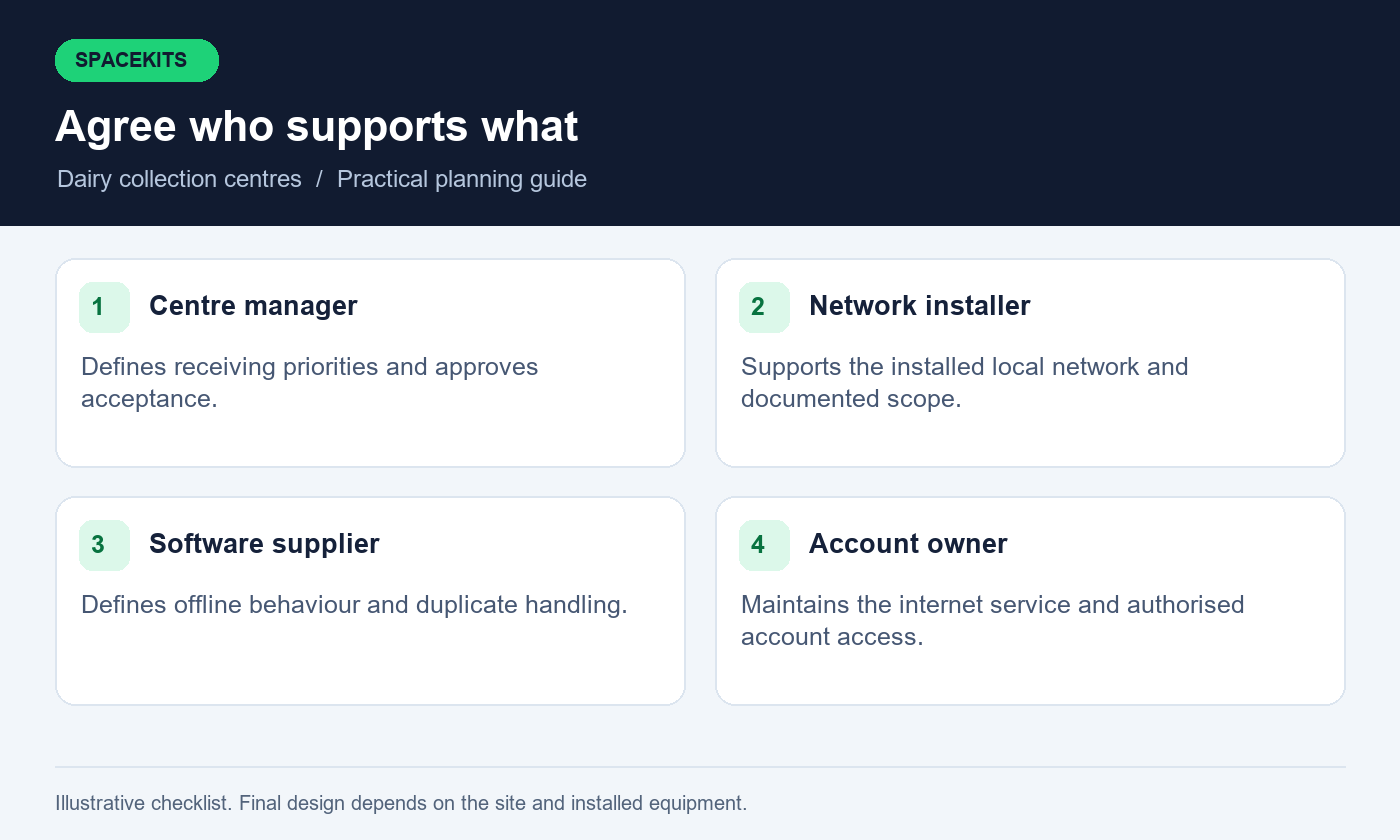
Request separate lines for hardware, mounting, cabling, internal networking, configuration, travel and testing. Ask who supplies the Starlink subscription and who owns the account. Confirm warranty and support arrangements in the written offer rather than relying on a general claim of after-sales service. The quoted scope should explain whether later visits, replacement parts and configuration changes are included or separately charged.
Keep the application supplier involved where network changes affect their system. The installer can test connectivity, but application permissions, duplicate handling and offline synchronisation may belong to another provider. Assign a lead contact for each responsibility. This avoids a familiar situation in which the network provider says the internet works while the software provider says the application is fine and nobody investigates the complete workflow.
Plan installation around receiving hours
Schedule installation of Starlink for dairy collection centres when the receiving operation can accommodate disruption. Tell the installer which periods cannot tolerate a cable change, power interruption or workstation relocation. If no quiet window exists, agree a staged approach with the operations manager. Do not assume that a technically quick change is operationally harmless. A short outage at the wrong time may affect more people than a longer planned maintenance period.
Prepare access before the visit. Confirm the person who can authorise mounting, unlock equipment rooms and explain the building layout. Arrange any required electrical assessment separately and in time. Verify the kit and accessories against the agreed list. Missing brackets, unsuitable cable routes or an unavailable account owner can turn an installation appointment into an incomplete visit even when the technician arrives on schedule.
Allow time for the acceptance tests and staff demonstration after the physical work. A centre should not resume full reliance on the new arrangement solely because the equipment lights are on. Keep the previous working connection available during a planned transition where practical and authorised. Remove or decommission old equipment only after the new service has passed the agreed checks and the owner has approved that step.
Train the receiving team to report useful symptoms
A support handover for Starlink for dairy collection centres should give operators observations they can make without altering settings. They can record the time, workstation, failed task and whether a nearby device has the same issue. They can note an ordinary status message exactly as displayed, while excluding private member information from screenshots. These details are more useful to support than a message saying that the internet is bad again.
Set boundaries for restarts and cable handling. Staff should follow an approved sequence for their particular equipment, not repeatedly switch everything off during an unresolved submission. A restart can interrupt other users and may erase useful diagnostic context. Where the software shows an uncertain transaction state, the application owner should guide the response. Never let a generic network checklist override the centre’s data-handling procedure.
Train a second person to cover absence and shift changes. Keep supplier contacts and equipment locations available offline. Review the procedure after the first real incident, asking what information was missing and which step confused staff. Short, realistic training that operators can demonstrate is more valuable than an elaborate manual that stays in the committee office.
Maintain an incident log without collecting unnecessary data
For Starlink for dairy collection centres, log symptoms, time, affected area, status, action and result. It should identify recurring patterns without becoming a duplicate store of member records. For example, receiving tablet two could not confirm test submission is a useful technical description. Copying a member’s full details into an informal support group is usually unnecessary for diagnosing the network path.
Agree who can see the log and how long operational notes are retained under the organisation’s own policy. Keep passwords, account recovery information and sensitive screenshots out of routine incident entries. If a supplier needs a diagnostic export, the responsible manager should review what it contains and use an appropriate transfer method. The goal is enough information to solve the problem, with clear control over what leaves the centre.
Review patterns at a practical interval. If failures occur only during a large upload, investigate scheduling and traffic management. If one desk is consistently affected, inspect its device and connection. If several sites fail against the same application while ordinary browsing works, involve the application provider. The log should lead to a targeted next step rather than a growing collection of unresolved complaints.
Example: a two-desk collection centre
Imagine a hypothetical centre with two receiving tablets and one office computer. Staff report that records occasionally remain pending during the morning rush. A site assessment finds that the office computer performs a large scheduled upload at the same time, while one tablet also has weak coverage behind a partition. The centre needs to investigate two separate constraints rather than treating every failure as a satellite issue.
The team agrees a test with sample records, changes the upload schedule under the office owner’s authority and improves the affected desk’s local connection. It then repeats the receiving workflow with both tablets active. The software supplier demonstrates how pending records are identified and reconciled after an interruption. The manager records the outcome and keeps the remaining limitations visible in the operating procedure.
This example illustrates a method; it is not a report of a SpaceKits installation or a promised result. At another centre, the cause might be an application error, damaged cable, power interruption or upstream service issue. The value of the method is that it separates causes, assigns the correct provider and tests the work against the actual receiving task.
Common questions before a dairy centre buys Starlink
Will Starlink make our dairy software work offline?
No. Offline operation is an application capability and an organisational procedure. Ask the software supplier what is supported and test it. An internet service can restore connectivity, but it cannot create offline features, reconcile duplicate records or correct application permissions by itself.
Do we need WiFi across the whole compound?
Only if the work requires it. Start with receiving, supervision and administration areas, then justify additional coverage. A targeted design can be easier to support than an oversized network serving places with no defined task. Future expansion can be documented without buying everything immediately.
Can the same connection serve staff phones?
It may be practical with suitable separation and capacity management, but operational tasks should remain the priority. Define the intended use and test simultaneous activity. Confirm any applicable provider terms rather than assuming that every form of sharing is covered by the chosen plan.
What is the correct installation price?
The answer depends on the site, kit, mount, cable route, internal network, travel and support scope. Ask for a current written quotation based on the same brief. Compare the total arrangement and exclusions, not simply the cheapest advertised hardware figure.
Can we use our existing router and access points?
Possibly. Have the installer check their condition, compatibility, capacity and configuration. Reuse can make sense when equipment supports the required design. It should not be promised before inspection, especially where old devices lack the controls or interfaces the centre needs.
Review Starlink for dairy collection centres after the first month
Set a review date when the connection has experienced ordinary receiving shifts. Compare the original acceptance record with actual incidents and staff feedback. Ask whether the most important tasks are more predictable, whether the offline procedure was understood and whether support reached the correct person. Do not judge the project only by how often someone ran a speed test.
Review recurring costs against the approved arrangement. Confirm which supplier invoices cover service, support and equipment, and check whether any optional work was added with proper authorisation. A clear cost record helps the committee plan the next period without confusing a one-time installation charge with a continuing obligation. Any change to the service should be considered against the centre’s demonstrated needs.
Ask operators about small daily obstacles. A charging lead that cannot reach the receiving position, a printer that loses its connection or a support number stored only on an unavailable phone can undermine a technically sound installation. These issues may be inexpensive to resolve once identified. Record the agreed correction and verify that it helps during a real shift.
Finally, update the brief for future purchases. Keep successful acceptance tests, remove assumptions that proved wrong and note equipment that can support expansion. The next committee or manager should inherit a useful operating record, not just receipts and an unexplained collection of devices. This makes the original investment easier to maintain and future decisions easier to justify.
Starlink for dairy collection centres: decision and handover checklist
Before approving Starlink for dairy collection centres, confirm service ownership, tested receiving tasks, outage procedures and support responsibility. The quotation should identify installed equipment and continuing charges. The acceptance record should show results at the actual workstations. Any remaining exclusions should be understandable to both management and operators.
Keep the equipment diagram, supplier contacts, operating procedure and test record together. Review them when the centre adds a workstation, changes software or extends the building. Expansion can alter both demand and coverage, so it should trigger a focused reassessment. Do not wait until staff develop informal workarounds that nobody has tested or documented.
To discuss a site assessment, request a written SpaceKits quote and describe the collection centre’s location, receiving hours, existing kit and essential tasks. You can also review the SpaceKits packages guide before preparing your brief. SpaceKits is an independent equipment and installation support provider. Confirm Starlink service terms directly and agree the local work, acceptance tests and support responsibilities in writing.
Need Starlink Installation or Network Optimization?
We help homes, offices, apartments, and businesses with Starlink installation, WiFi coverage improvement, and professional setup in Kenya.
Request Installation Chat on WhatsApp